


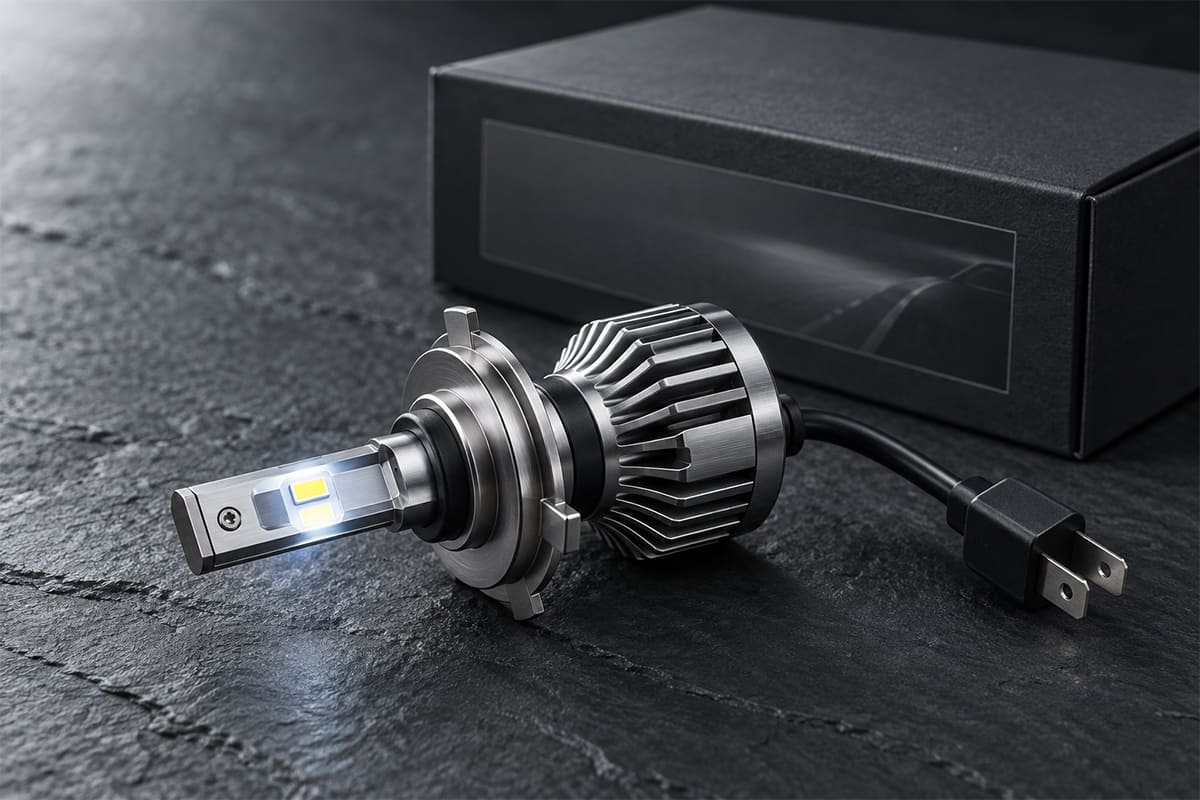
Any LED car bulb box displays a series of numbers intended to impress: wattage in watts, luminous flux in lumens, color temperature in Kelvin, degree of protection, chip type. The problem is that not all of these values are measured the same way, and some of them are chosen specifically to look good on the packaging, not to describe the product’s actual performance.
Understanding what each specification actually means transforms the choice from a guessing exercise into an informed decision. Here’s how to correctly read the numbers that matter.
Lumenii, the most manipulated figure on the market
The luminous flux, expressed in lumens, is the value that manufacturers most aggressively advertise. It is also the one most frequently exaggerated.
A standard 55W halogen bulb produces approximately 1,500 lumens. A good quality LED bulb produces between 6,000 and 10,000 real lumens per bulb. The declared values of 30,000, 50,000 or even 100,000 lumens per set have no connection with standardized photometric measurements — they are usually theoretical calculations based on the maximum specifications of the LEDs, under conditions that never occur in a real headlight.
A useful hint: if a bulb really produced 30,000 lumens, it would require an electrical power and thermal dissipation impossible to achieve in a housing the size of a headlight bulb. Physics sets clear limits, and the figures that exceed them spectacularly are marketing, not specifications.
More relevant than the absolute number is the ratio between the declared value and the product price. A bulb that promises three times more lumens than the competition at half the price raises questions, not enthusiasm.
Power in watts — what it says and what it doesn’t say
The power consumed indicates how much electricity the bulb uses, not how much light it produces. An efficient LED bulb consumes between 20 and 40W and produces significantly more light than a 55W halogen bulb.
Here comes another marketing practice: some products display values of 150W, 200W or 300W per set. These are theoretical peak figures or powers summed up under unrealistic conditions, not real consumption in operation. A bulb that would actually consume 150W would require a much larger cooling system than the space in the headlight allows and would overload the car’s electrical system.
The actual consumption is lower than that of halogen — this is, in fact, one of the advantages of LED technology; it is not a problem that needs to be compensated for with large figures.
Color temperature, the only figure that is difficult to fake
Expressed in Kelvin, the color temperature describes the shade of light and is one of the few specifications that are easily verified visually after installation.
Values between 4,300K and 5,000K produce a warm to neutral white, close to the original xenon of premium cars. Between 5,500K and 6,500K, the modern cool white is obtained, the most popular for upgrades and the best compromise between appearance and real visibility. Above 7,000K, the light takes on a bluish tinge that looks spectacular in photos but reduces actual visibility on wet roads or in foggy conditions.
For daily use, the 5,500K–6,500K range remains the reasonable recommendation.
The type of face, the specification that really matters
This is where the real difference in quality lies, although the information is displayed most discreetly on the packaging. LED H7 bulbs and on the other popular headlights, the type of headlights largely determines both the intensity of the light and the precision of the beam produced by the headlight.
CSP (Chip Scale Package) chips are the current standard for quality automotive bulbs. They are compact, have high luminous density, and allow the precise positioning necessary for a correct beam. The type codes 7035, 8035, or 3570 indicate the generation and size of the chip.
COB (Chip on Board) lamps group several LED sources on a single plate and produce a uniform light, but with less precise control of the beam.
Products that do not specify the type of LEDs at all usually use old-generation LEDs that are cheaper and less efficient. The absence of this information is in itself a clue.
What specifications are worth checking before ordering
Beyond the impact figures, several technical details directly influence the final result:
- IP protection rating — IP65 is the minimum acceptable, IP67 or IP68 for bulbs mounted in headlights exposed to moisture
- Total dimensions — the length of the bulb with the radiator or fan included, compared to the space available behind the headlight
- CANBUS compatibility — explicitly mentioned, not just suggested by vague formulations
- Operating voltage — 12V for passenger cars, 12–24V for extended compatibility with commercial vehicles
- Declared lifespan — between 30,000 and 50,000 hours for quality products
- What doesn't appear on the packaging, but matters the most
There is one aspect that no specification describes: the quality of the filament produced in the headlight. A bulb can have excellent numbers in all the chapters and yet produce poorly distributed light if the positioning of the chips does not faithfully reproduce the geometry of the original halogen filament.
This parameter cannot be read from the box. It is only checked through the reviews of other users with the same model of car, through actual testing after assembly, or by choosing products from sellers that offer the possibility of return in case of unsatisfactory results.
A good choice means less chasing after the highest numbers and more checking the consistency between the specifications. Realistic lumens, reasonable consumption, a color temperature between 5,500K and 6,500K, explicitly mentioned CSP chips, and an adequate degree of protection together describe a serious product. Spectacular figures, on the other hand, often only describe the ambition of the marketing department.





