In short: RO e-Transport is mandatory for shipments of high fiscal risk goods within Romania and for international shipments that start or end in the country. Since January 1, 2026, penalties for failing to transmit GPS data to ANAF (Romanian tax authority) have been fully enforced, after the grace period ended. The haulier must hold a valid UIT code before departure and transmit the vehicle's position throughout the entire trip.
e-Transport is a notification (declaration) that must be filed, as required by law, for shipments of fiscal risk goods within Romania or for international shipments.
The relevant data concerns road freight shipments of high fiscal risk goods within Romania, with the aim of monitoring them, in accordance with OUG 41/2022.
The reason for this nationwide platform is to reduce tax evasion.
What is e-Transport and what does it mean in Romania?
Through an Emergency Ordinance, the project for an electronic monitoring system for fiscal risk road shipments was approved.
In short, the state will monitor all domestic shipments of goods in the fiscal risk categories, and internationally it will monitor all goods loaded or unloaded in the country. Under these measures, hauliers will be required to install GPS fleet tracking devices, if they don't already have one.
The driver will be required to turn on the GPS device before starting the shipment on national territory and turn it off only after delivering the goods to the declared destination or after leaving Romanian territory.
In addition, the driver must present, at the request of the competent authorities within ANAF or the Romanian Customs Authority, as well as at the request of the police, the documents accompanying the goods monitored through the RO e-Transport system, together with the UIT code.
If you want an easier way to understand which shipments require a UIT code, you can download a flowchart created by our team by clicking Click Here.

Which goods fall into the fiscal risk category?
According to the latest ANAF announcement, the products that count as fiscal risk goods are the following:
1. Meat and edible offal (0201 to 0210 inclusive);
2. Fish and crustaceans, mollusks and other aquatic invertebrates (0302, 0304 and 0306);
3. Dairy produce; birds' eggs; natural honey; edible products of animal origin, not elsewhere specified or included (0401 to 0407 inclusive, and 0409);
4. Edible vegetables and certain roots and tubers (0701 to 0714 inclusive);
5. Edible fruit and nuts; peel of citrus fruit or melons (0801 to 0814 inclusive);
6. Beverages, spirits and vinegar (2201 to 2208 inclusive);
7. Tobacco and manufactured tobacco substitutes; products, whether or not containing nicotine, intended for inhalation without combustion; other nicotine-containing products intended for the intake of nicotine into the human body (2401 and 2403);
8. Salt; sulfur; earths and stone; plastering materials, lime and cement (2505 and 2517);
9. Mineral fuels, mineral oils and products of their distillation; bituminous substances; mineral waxes (2710 19 66, 2710 19 99, 2710 19 81, 2710 19 83, 2710 19 87 and 2707 99 99);
10. Soap, organic surface-active agents, washing preparations, lubricating preparations, artificial waxes, prepared waxes, polishing or scouring preparations, candles and similar articles, modeling pastes, “dental waxes” and dental preparations with a basis of plaster (3403 19 10 and 3403 19 80);
11. Miscellaneous chemical products (3814 00 90);
12. Articles of apparel and clothing accessories, knitted or crocheted (6101 to 6117 inclusive);
13. Articles of apparel and clothing accessories, not knitted or crocheted (6201 to 6212 inclusive and 6214 to 6217 inclusive);
14. Other made-up textile articles; sets; worn clothing and worn textile articles; rags (6309);
15. Footwear, gaiters and the like; parts of such articles (6401 to 6405 inclusive);
16. Iron and steel (7213 and 7214).

What types of transport are affected?
Not all types of shipments are covered by this measure. You are affected by e-Transport if your shipments fall into one of the categories below:
- shipments that start and end within the country;
- shipments that start in Romania (e.g., export, intra-Community supply);
- shipments that end in Romania (e.g., import, intra-Community acquisition);
Who has to declare the shipment data?
The obligation to declare goods shipment data in the RO e-Transport System, in order to obtain the UIT code, lies with the following categories of users:
- the Romanian supplier, for domestic transactions;
- the business operator, for high fiscal risk goods held and transported between loading and unloading locations within national territory.
For international goods shipments, the obligation to declare the data lies with:
- the consignee listed in the import customs declaration or the consignor listed in the export customs declaration, for goods subject to import or export operations;
- the Romanian buyer, for intra-Community acquisitions of goods;
- the Romanian supplier, for intra-Community supplies of goods;
- the warehouse keeper, for goods subject to intra-Community transactions in transit, both for goods unloaded in Romania for storage or for forming a new shipment from one or more consignments of goods, and for goods loaded after storage or after forming a new shipment within national territory from one or more consignments of goods.
What are the criteria that require you to transmit GPS data in e-Transport?
When high fiscal risk goods are transported, the following conditions must be met.
- The vehicle has a technically permissible maximum mass of at least 2.5 tons;
AND
- It carries goods with a total weight of more than 500 kg;
OR
- The goods shipment has a total value of more than 10,000 lei, excluding VAT.

Is there a platform for e-Transport?
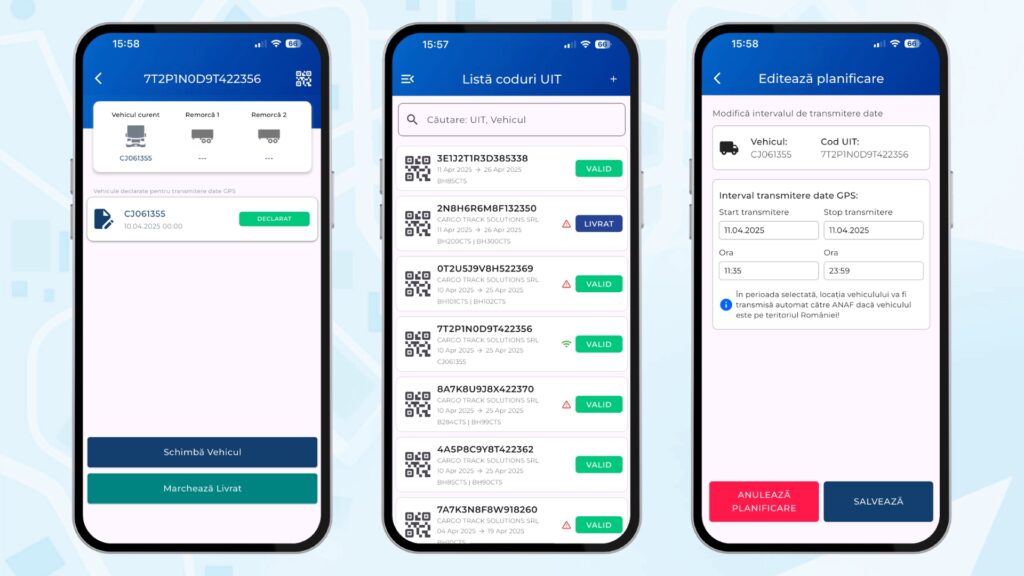
CargoTrack has developed a special module dedicated to hauliers. With this module, you can transmit GPS data to ANAF directly from the GPS fleet tracking app. We even offer a 100% automated version.
ANAF provides hauliers with a free-access platform that can be accessed from both computer and mobile. Here you can enter shipment data or generate the UIT code. It can be downloaded from AppStore OR Google Play.

Who generates the UIT code?
The UIT code is generated after the shipment is declared. It is a unique code generated by the RO e-Transport System that identifies the data for a consignment of goods.
The road transport operator is required to provide the driver with the UIT code received.
The haulier does not have to generate the UIT code. It only has to make sure it has the code before setting off.
Attention!
Even though the haulier does not generate the UIT code, it is required to make sure the driver has it before starting the trip.
Transmitting GPS data to ANAF for shipments of high fiscal risk goods is entirely the haulier's responsibility.
How long is a UIT code valid?
The UIT code is generated automatically by the platform after the data is entered, no more than 3 days before the shipment date, and is valid for 5 calendar days for domestic shipments and 15 calendar days for intra-Community acquisitions of goods, as well as for the commercial operations provided for in art. 2 item 9 letters g) and j) of OUG no. 41/2022 , starting from the declared shipment start date.
The road transport operator is prohibited from using the UIT code after its validity period.
If the shipment in question is canceled, returned or only partially completed, a new UIT code will be generated.
What are the fines for non-compliance?
If the driver does not present the UIT code at the request of the competent authorities, the fine is between 5,000 and 10,000 lei.
However, for the haulier's failure to transmit the trip details via GPS, fines can range from 20,000 to 100,000 lei.
Update
Penalties postponed – April 24, 2025
The application of fines for failing to transmit GPS data to the RO e-Transport system was postponed until January 1, 2026, according to OUG no. 29/2025, published in Official Gazette no. 365 of April 24, 2025.
What does this mean for you?
Until the beginning of next year, you will not be fined if you do not transmit GPS data to ANAF for shipments of high fiscal risk goods.
Attention!
The obligation to declare shipments and present the UIT code during an inspection remains in force.
The postponement applies only to GPS data transmission.
If you haven't done so yet, now is a good time to equip your trucks with GPS and use the e-Transport module.
Penalties applied from April 1, 2025
Emergency Ordinance no. 129/2024 once again postponed the application of penalties for failing to transmit GPS data to ANAF.
Hauliers have until March 31, 2025 to prepare, with penalties applied only starting April 1, 2025.
Postponement of penalties
The grace period was extended until December 31, 2024. As a result, penalties will be applied only starting January 1, 2025.
Postponement – June 28, 2024
According to the latest decision of the Romanian Government of June 28, 2024, penalties for non-compliance with e-Transport legislation were postponed until January 1, 2025, but ONLY for authorized economic operators (AEO).
Testing period between July 15 and October 1, 2024
ANAF and The Ministry of Finance published a new clarification on July 2, 2024. It provides for an application testing period from July 15 to October 1, 2024.
WARNING! This does not mean hauliers no longer have to transmit GPS data or present the UIT code. Even though we are in a testing period, inspections have already begun, with penalties of over 20.48 million lei applied (including administrative fines, confiscations and tax consequences).
The e-Transport Module – CargoTrack
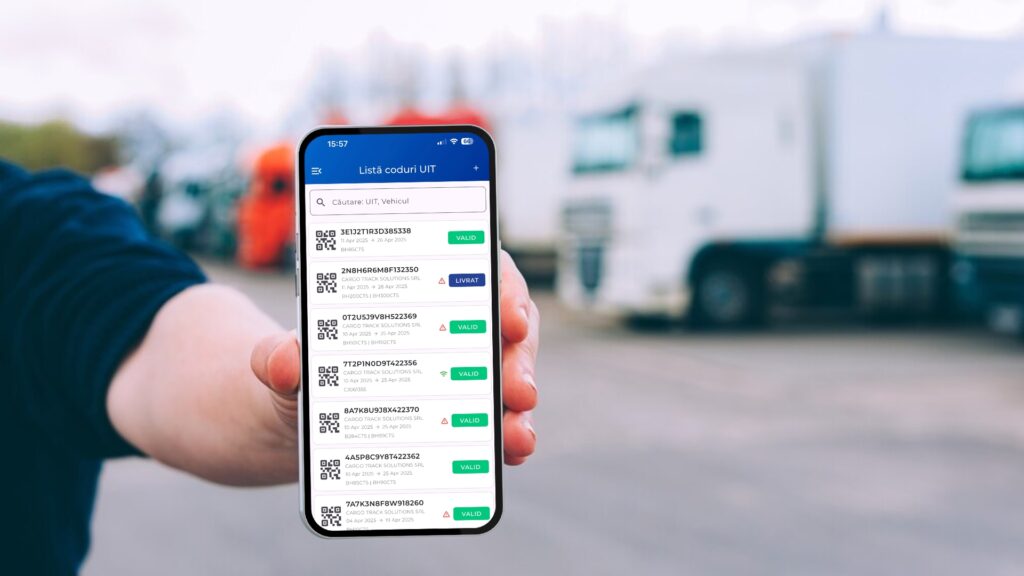
Currently, e-Transport module can be used in the CargoTrack app. This module was developed specifically for hauliers to make their work easier.
The module can be used from a laptop/computer as well as on mobile. It is free for all customers who have GPS equipment and a GPS subscription with us.
For this module, you can choose between 2 options:
BASIC
This is a free option, available if you have active GPS equipment and a GPS subscription with us.
Entering UIT codes and vehicle data and creating or editing declarations is done manually, directly from the platform.
PREMIUM
The premium option automates the entire process, making your work easier.
This is a period in which these changes will be rolled out gradually. Using this procedure, and the UIT code, will be unavoidable for hauliers.
Fortunately, development of our e-Transport app is in its final phase. It will make your work considerably easier, as our interface is extremely easy and intuitive to use, saving you time and effort.
If you'd like the e-Transport module too, Contact us!
Frequently Asked Questions about e-Transport and the UIT Code
Is e-Transport mandatory in 2026 for all transport companies?
Yes, but only for certain categories of shipments. The RO e-Transport system, established by OUG no. 41/2022, applies to shipments of high fiscal risk goods within Romania and to international shipments that start or end in the country, including imports, exports, and intra-Community acquisitions and supplies. A strictly domestic shipment of goods that are not on the list of fiscal risk goods is not subject to this obligation.
When are fines for failing to transmit GPS data to ANAF actually applied?
The grace period for failing to transmit GPS data ended on December 31, 2025, and penalties have applied since January 1, 2026. The postponement had been set by OUG no. 29/2025, published in Official Gazette no. 365 of April 24, 2025, following earlier postponements granted by OUG no. 129/2024. Today, hauliers who do not transmit the vehicle's position throughout the entire trip can be penalized.
Who generates the UIT code and who is responsible for transmitting GPS data?
The UIT code is declared by the consignor, buyer or warehouse keeper, depending on the operation: the Romanian supplier for domestic transactions and intra-Community supplies, the buyer for intra-Community acquisitions, and for imports or exports the consignee or consignor listed in the customs declaration, respectively. The road transport operator does not generate the code, but it must have it before departure and is fully responsible for transmitting GPS data to ANAF.
When is a shipment subject to the e-Transport declaration requirement?
The obligation applies when the goods are on ANAF's list of high fiscal risk goods and the vehicle has a technically permissible maximum mass of at least 2.5 tons. In addition, the consignment must exceed either 500 kilograms of total gross weight or 10,000 lei in value, excluding VAT. For international shipments, the obligation applies whether or not the goods are on the fiscal risk list.
How long is the UIT code valid and what do I do if the shipment is canceled?
The UIT code is generated no more than 3 days before the declared shipment date and is valid for 5 calendar days for domestic shipments and 15 calendar days for intra-Community acquisitions and certain commercial operations provided for by OUG no. 41/2022. Using the code after its validity period has expired is prohibited. If the shipment is canceled, returned or only partially completed, a new UIT code must be generated.
What fines do the driver and the company face for breaking e-Transport rules?
A driver who does not present the UIT code and the accompanying documents at the request of inspectors faces a fine of 5,000 to 10,000 lei. Legal entities that do not declare the shipment, declare quantities different from the actual ones or do not follow the procedure face a fine of 20,000 to 100,000 lei, under OUG no. 41/2022. In certain cases, the fine may be accompanied by confiscation of the value of the undeclared goods.
What must the driver carry during an e-Transport inspection?
During an inspection, the driver needs the valid UIT code and the documents for the goods, which they show to ANAF inspectors, the Romanian Customs Authority or the police. The driver is also responsible for the operation of the monitoring device: it is activated at the start of the trip on national territory and stays on until the goods reach the declared address or the truck leaves the country.