


RO e-Transport, run by ANAF (Romanian tax authority), is a GPS monitoring system for goods considered to carry a high fiscal risk. These products can be easily identified by checking the official list published by ANAF.
The purpose of the RO e-Transport system is to monitor the transport of high fiscal risk goods by declaring them and tracking them in real time, in order to prevent tax evasion and ensure the transparency and fairness of commercial operations.
What are the steps for declaring correctly in the ANAF e-Transport system?
The complete process, from A to Z, involves both the declarant and the haulier. The declaration does not have to be made by the haulier, so the the UIT code is not generated by the haulier but provided to them by the beneficiary, warehouse keeper or supplier.
The declaration steps are as follows:
1. Accessing the ANAF platform (SPV) or software connected to e-Transport;
2. Filling in the details of the shipper, consignee, goods and value;
3. Submitting the declaration in the ANAF system;
4. Obtaining the UIT code, generated automatically by ANAF.
The steps listed above not part of the haulier's obligations.
Here is what the haulier has to do next:
5. Receiving the UIT code – the haulier must receive the UIT code from the customer before departure;
6. Including the UIT code in the transport documents – CMR, delivery note, invoice or other documents accompanying the goods;
7. Passing the code on to the driver – so that they can present it to the authorities in case of an inspection;
8. Sending GPS data to ANAF – if the vehicle is equipped with a monitoring system, the haulier must make sure the data is sent correctly for the duration of the transport.
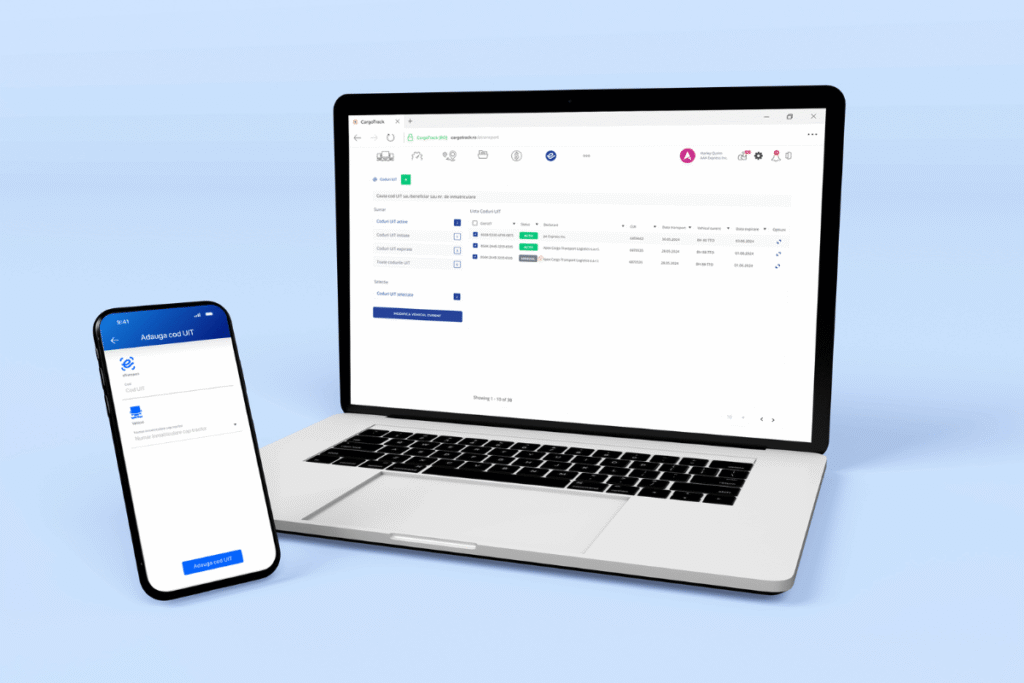
What information does the declaration contain?
The ANAF e-Transport declaration contains information about who is transporting, what is being transported, from where to where, as well as details about the vehicle and the time period — all of which are needed to generate the UIT code and track the transport via GPS.
1. Participant data
- The shipper and the consignee of the goods (name, CUI tax ID, full address);
- The beneficiary (if different from the shipper/consignee);
- The haulier and, where applicable, the subcontractor;
- The driver's identification details (last name, first name, CNP personal numeric code or ID document number).
2. Goods data
- The full name of the goods transported;
- The CN (Combined Nomenclature) codes of the goods;
- The quantity transported (in kg or other specific units of measure);
- The value of the goods (in lei, excluding VAT);
- The fiscal risk category (if the goods are considered high-risk).
3. Transport data
- The loading and unloading locations (full addresses, country, town, postal code);
- The estimated date and time of departure and arrival;
- The type of transport (domestic, intra-community, import, export);
- The vehicle registration number (tractor unit and trailer/semi-trailer);
- The vehicle type (van, truck, semi-truck, etc.).
4. Additional system-generated data
- The UIT code, assigned automatically by ANAF after the declaration is validated;
- The validity of the UIT code (5 days for domestic transport, 15 days for international/intra-community transport).
What do you do with the UIT code if the truck breaks down?
ANAF e-Transport allows the haulier to amend the declaration if the truck breaks down. You can amend the declaration in SPV and enter the details of the new vehicle that will replace the broken-down truck.
Declaring transports is nothing new anymore, either for the declarant or for the haulier. Even though the enforcement of fines for GPS monitoring was postponed, declaring and presenting the UIT code remained mandatory.
As of January 1, 2026, this changed. Since then, sending GPS positions to ANAF has also been mandatory for transports of high fiscal risk goods.
Watch out for fines and get your trucks ready in good time with GPS fleet tracking devices.
How to send data to RO e-Transport automatically
Generating the UIT code is only the first step. The system then also requires the vehicle's positioning data to be sent for the duration of the transport, and this is where manual reporting becomes impractical at volume.
CargoTrack automatically sends GPS data to the ANAF RO e-Transport system, directly from the on-board equipment, with no manual operation for each run. The same equipment also covers fleet monitoring, tachograph data download and road toll payment.
Details about the CargoTrack solution for RO e-Transport.
Frequently asked questions about generating the UIT code
How is the UIT code generated in ANAF e-Transport?
The UIT code is generated automatically by the ANAF system after the transport declaration is completed and validated in SPV or in software connected to e-Transport. It cannot be generated manually or requested separately.
Who makes the declaration in the e-Transport system?
The declaration is made by the beneficiary, supplier or warehouse keeper, not by the haulier. The haulier receives the UIT code from the customer before departure and includes it in the transport documents.
What information does the e-Transport declaration contain?
The declaration contains the shipper's and consignee's details, the driver's details, the name and CN codes of the goods, their quantity and value, the loading/unloading locations, the type of transport and the vehicle registration number.
What do you do with the UIT code if the truck breaks down?
The declaration can be amended in SPV: you enter the details of the new vehicle replacing the broken-down truck, without the need for a new UIT code.
Is it mandatory to send GPS positions to ANAF?
Yes. Since January 1, 2026, sending GPS positions to ANAF has been mandatory for transports of high fiscal risk goods, and non-compliance is punishable by a fine.
Which GPS solution helps with RO e-Transport reporting to ANAF?
CargoTrack automatically sends positioning data to the RO e-Transport system, directly from the on-board equipment installed on the vehicle. The haulier does not have to report the position manually for each run.
Do you need separate equipment for e-Transport?
No. With CargoTrack, reporting to RO e-Transport is done from the same equipment that handles GPS monitoring, tachograph data download and road toll payment. Installation is free and is carried out at the vehicle's location within 48 hours at most.