



In short: starting January 1, 2021, commercial vehicles with a maximum authorized weight over 3.5 tons operating in France must display blind spot warning markings. These are 25 x 17 cm stickers applied on both sides and at the rear, with at least 3 required for a tractor and semi-trailer combination. The obligation is set out in Decree No. 2020-1396 of November 17, 2020, and missing or incorrectly applied markings are punishable by a fine of between 135 and 750 euros.
Starting January 1, 2021, blind spot signage on commercial vehicles over 3.5 tons operating in urban areas becomes mandatory in France!
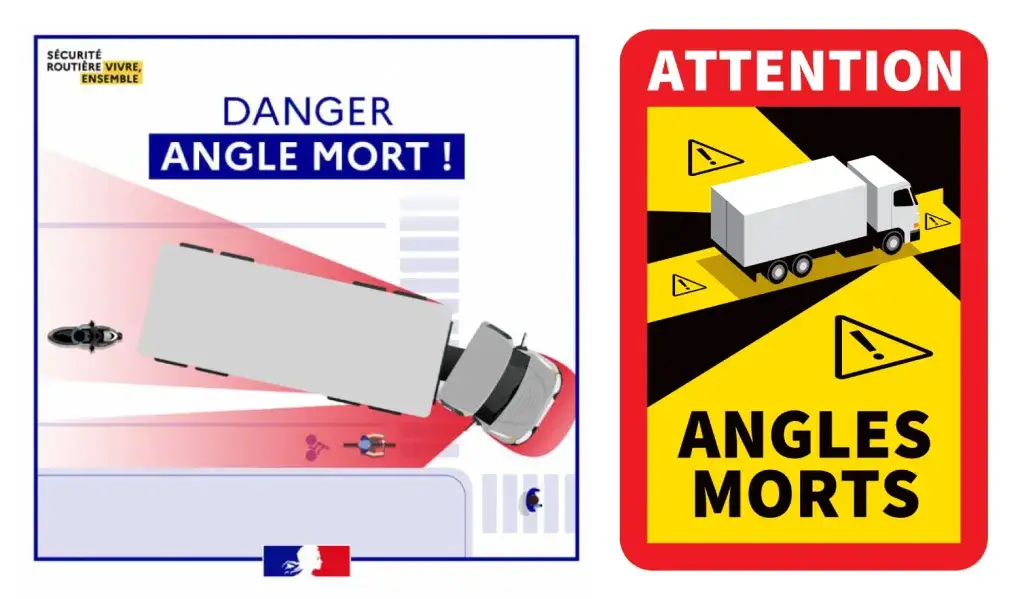
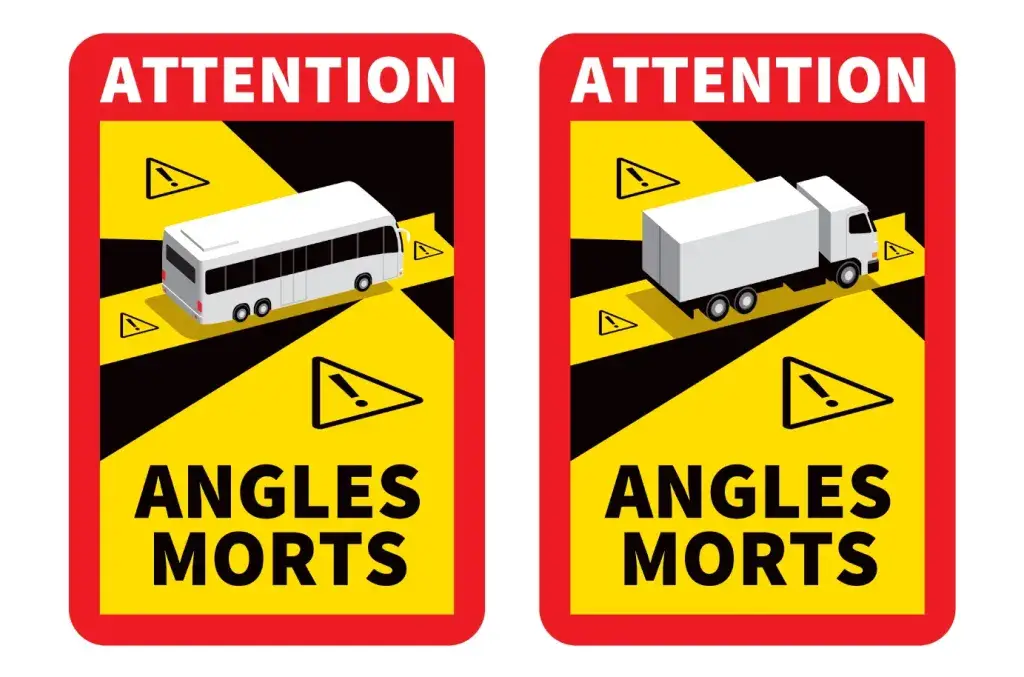
Vehicles will have to be fitted with special warning markings (25 x 17 cm stickers) on both sides and at the rear to warn pedestrians and cyclists about the danger of blind spots.
A road combination (tractor + semi-trailer) needs at least 3 stickers.

While blind spots on a car or a van can be reduced easily, on a heavy commercial vehicle such as a truck, bus or coach they are hard to eliminate. The vehicle’s size and the driving position cause blind spots, and they cannot be removed completely, even when vehicles are fitted with assistance systems.
The decision was made to further protect vulnerable road users (pedestrians and cyclists) so that they do not stay in those blind spots.
In cities, the blind spot of heavy vehicles is a major danger for cyclists and pedestrians. For example, if a truck or bus is stopped at a traffic light and wants to turn left or right, because of the blind spots the driver might not notice a pedestrian or cyclist. To keep these road users out of the blind spots, they need to be made aware of them.
Fines for not complying with the new mandatory legislation in France
If the stickers are not applied at all or are applied incorrectly (see specifications in Decree No. 2020-1396 of November 17, 2020), the driver/haulier risks a fine of between 135 euros and 750 euros. Watch out!
Frequently asked questions about the new mandatory legislation in France
Which vehicles are affected by the new mandatory legislation in France?
- Any vehicle with a maximum authorized weight over 3.5 tons.
Which vehicles are exempt from the new mandatory legislation in France?
- agricultural and forestry vehicles;
- vehicles used for winter operations;
- emergency and service vehicles of highway and secondary road management services;
- timber transport vehicles (logging trucks)
- motor vehicles and towed vehicles on which, for structural/technical* reasons, side and/or rear markings cannot be applied.
How can the signage be applied to the vehicle?
- Gluing;
- Riveting;
- Painting/Drawing – keeping the shape/size/colors identical
- The marking applied/glued in a pocket.
- Any other secure fastening method;
Are vehicles registered in other countries required to comply with the new mandatory legislation in France?
If they already display, on the sides and at the rear, a sign indicating the presence of blind spots under the legislation of another EU member state, no additional markings will be required.
What about vehicles already fitted with a model that does not match the model shown in the annex to the draft?
If these vehicles are fitted on the sides and at the rear before March 31, 2021, they will be considered compliant only for a period of 12 months from the publication of the order in the official journal.
Where should the signage be applied?
The signage must be placed so that it is visible in all situations and does not obstruct the visibility of other regulatory plates, vehicle lettering, lights and signaling devices, or the driver’s field of vision.
Are there regulatory requirements for positioning the signage?
Yes. The signage must be placed in a specific location set out in Article 2.
The signage must be applied at the rear of the vehicle, to the right of the longitudinal median plane (between 0.9 and 1.5 m above the ground), and on each side, except on glass surfaces, within 1 m of the front and at a height between 0.9 and 1.5 m above the ground.
Are there exceptions to this positioning?
Yes, in case of technical impossibility*.
Note*: Technical impossibility means it is impossible to attach the signage within the area set by the decree (for example: a glazed surface).
Deviation from the height requirements:
- For motor vehicles and towed vehicles on which it is technically impossible to meet the required height of the signage above the ground, the signs shall be placed as close as possible to the height prescribed in Article 2 of this decree and no higher than 2.10 meters.
Deviation from the side positioning requirements:
- Vehicles with direct vision systems in the lower part of the doors or door windows are fitted with signs placed at a distance from the front of the vehicle as close as possible to that set out in Article 2 of this decree and within 3 meters. The 3-meter limit may be waived when the vehicle’s structure does not allow the signs to be positioned in line with this article without obstructing part of the windows.
- The positioning criteria for side signs do not apply to towed vehicles where there is a technical impossibility. These vehicles carry the side signs in a position compatible with their technical characteristics.
Deviation from the rear positioning requirements:
- The positioning criteria for rear signage do not apply to motor vehicles and towed vehicles where there is a technical impossibility. These vehicles are marked at the front and rear in a location compatible with their technical characteristics.
Examples: container carriers; – car transporters; – tractors for semi-trailers; – tank vehicles; – flatbed vehicles; – hook lifts for demountable bodies; – dollies, etc.
The regulation also applies to vehicles registered outside France, but if they are already fitted with warning signs in line with the legislation of another EU member state, French enforcement authorities will accept those signs.





