



In short: Under Mobility Package 1, the weekly rest period requirement came into force on August 20, 2020. Drivers employed in international freight transport may take two consecutive reduced weekly rest periods outside the member state where the company is established. The condition is that, in the following four weeks, the driver takes at least four weekly rests, two of which must be regular weekly rest periods, and that the reduced rests are compensated in a single block before the end of the third following week. A maximum of 3 weeks may pass between two 45-hour rests, as long as the rest falls between two weeks, and reduced 24-hour breaks are required at intervals of 144 hours (6 days).
Mobility Package 1 contains numerous new rules on rest periods, the posting of professional drivers, market access and social legislation. The aim of this law is a safer, more efficient and socially responsible road transport sector.
Mobility Package 1 also removes unclear rules that led to differing legal interpretations and enforcement practices in each member state, providing greater legal clarity across the EU.
Below, we’ll focus on weekly rest periods, a requirement that came into force on August 20, 2020.
Weekly rest periods

Companies with drivers employed in international freight transport will be allowed to have them take two consecutive reduced weekly rest periods outside the member state where the company is established.
However, this will be subject to the condition that, in the following four weeks, the driver takes at least four weekly rests, two of which must be regular weekly rest periods.
Reduced rest periods must be compensated with equivalent rest periods, taken without interruption before the end of the third week following the week in question.
So we can conclude that, under certain conditions, a driver may take two consecutive reduced weekly rest periods, and the compensation for the reduced weekly rest must be taken in a single block before the end of the third week following the week in question.
Rest periods diagram
To help you out, we provide a chart you can use to calculate your weekly rest so that you comply with the new Mobility Package 1 law – weekly rest.
The table accepts, as a correct on-the-road solution, a maximum of 3 weeks between 2 rest breaks of 45 hours, as long as the rest falls between 2 weeks.
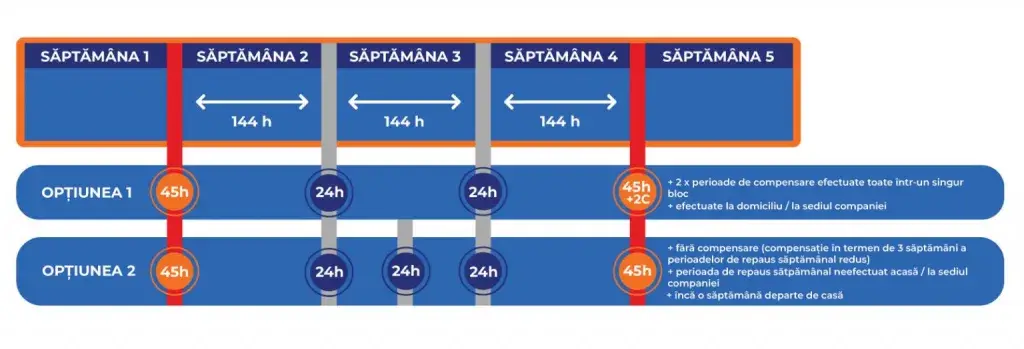
The 45-hour rest between week 1 and 2: must fall between the weeks, even by 1 minute
45-hour break between week 4 and 5: must fall between the weeks, even by 1 minute.
Between them, all reduced 24-hour breaks must be taken, required at intervals of 144 hours (6 days) between them. If any of these intermediate breaks is taken as 45 hours, the police may require it to be taken outside the cab as well; if they are shorter than 45 hours, they may not.
Read more about Mobility Package 1 here:
https://cargotrack.ro/blog/noi-reglementari-ale-pachetului-mobilitate-1/
Frequently asked questions
When did the Mobility Package 1 weekly rest rule come into force?
The Mobility Package 1 weekly rest period requirement came into force on August 20, 2020.
Can a driver take two consecutive reduced weekly rest periods?
Yes, drivers employed in international freight transport may take two consecutive reduced weekly rest periods outside the member state where the company is established. The condition is that, in the following four weeks, the driver takes at least four weekly rests, two of which must be regular weekly rest periods.
How are reduced weekly rest periods compensated?
Reduced rest periods must be compensated with equivalent rest periods, taken without interruption, in a single block, before the end of the third week following the week in question.
How many weeks can pass between two 45-hour rests?
A maximum of 3 weeks may pass between two 45-hour rest breaks, as long as the rest falls between two weeks. Between them, reduced 24-hour breaks are required at intervals of 144 hours (6 days).
Is it mandatory to take the weekly rest outside the cab?
If an intermediate break is taken as 45 hours, the police may require it to be taken outside the cab. If the breaks are shorter than 45 hours, this requirement does not apply.





