

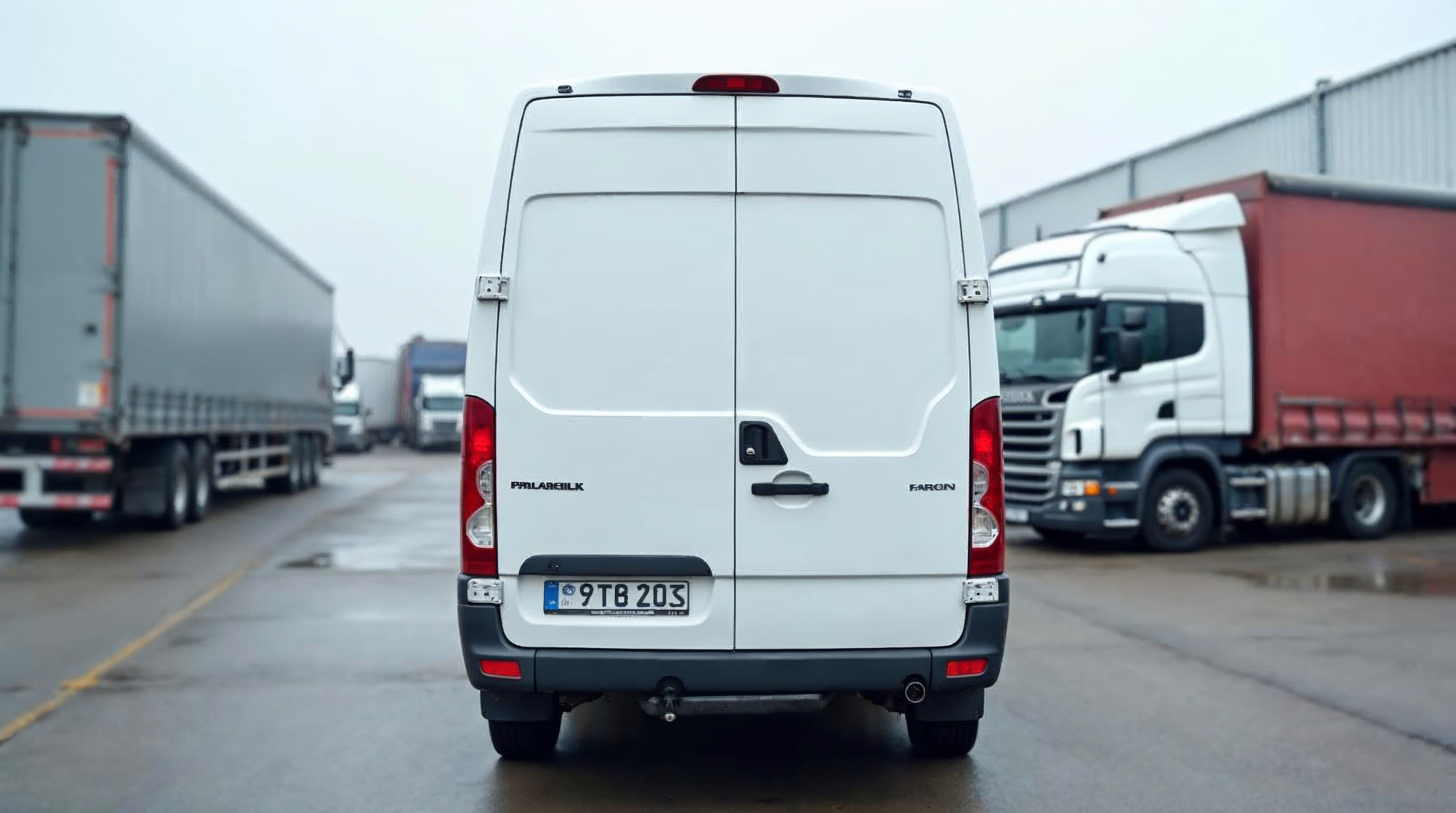
A tachograph is mandatory on goods vehicles whose maximum authorized weight exceeds 3.5 tons and, as of July 1, 2026, also on those over 2.5 tons engaged in international transport or cabotage. The threshold is calculated on the maximum authorized weight of the combination – vehicle plus trailer or semi-trailer – not on the weight of the goods carried.
The rule comes from Regulation (EC) No 561/2006, as amended by Regulation (EU) 2020/1054 (Mobility Package 1). Below are the exact thresholds, the exemptions that matter in practice and what you risk if you calculate them wrong.
From What Weight You Need a Tachograph – the 2026 Thresholds
| Type of operation | Maximum authorized weight | Tachograph mandatory? | Legal basis |
| Freight transport, domestic (Romania only) | over 3.5 t | Yes | Art. 2(1)(a) |
| Freight transport, domestic | up to and including 3.5 t | Not | — |
| Freight transport, international or cabotage | over 2.5 t | Yes, from July 1, 2026 | Art. 2(1)(aa) |
| Freight transport, international or cabotage | up to and including 2.5 t | Not | — |
| Passenger transport | vehicles built for more than 9 people (including the driver) | Yes, regardless of weight | Art. 2(1)(b) |
Watch the wording: the law says “exceeds 3.5 tons” and “exceeds 2.5 tons,” respectively. A vehicle with a maximum authorized weight of exactly 3,500 kg does not exceed the threshold, so it is not subject to the requirement for domestic transport. The difference between 3,500 kg and 3,510 kg completely changes the vehicle’s legal status.
How the weight is calculated: maximum authorized weight, not the cargo
The threshold refers to the maximum authorized weight listed in the vehicle’s registration certificate, not to how much the load actually weighs. A 3.5-ton van driving empty is still a 3.5-ton vehicle in the eyes of the law.
The real trap is the trailer. The text of the regulation explicitly says “vehicles, including vehicles with a trailer or semi-trailer, whose maximum authorized weight exceeds 3.5 tons.” In practice:
- 3.5 t van, no trailer, domestic transport → no tachograph;
- The same 3.5 t van with a 750 kg trailer → the combination exceeds 3.5 t → tachograph mandatory;
- 3 t van running trips to Hungary or Germany after July 1, 2026 → exceeds 2.5 t in international traffic → tachograph mandatory.
What changed on July 1, 2026 for 2.5–3.5-ton vehicles
Mobility Package 1 added a new point to Regulation 561/2006, Art. 2(1)(aa), which extends the social rules to “the carriage of goods in international transport operations or in cabotage operations by vehicles, including vehicles with a trailer or semi-trailer, whose maximum authorized weight exceeds 2.5 tons, short for July 1, 2026.”
The deadline has already passed. If you have light vehicles that leave the country or do cabotage, they must now have a tachograph, and their drivers need a tachograph card and must comply with driving and rest times. For strictly domestic transport, the threshold remains 3.5 tons.
This vehicle category is the only one where the requirement is recent, so it’s also where the most mistakes are made: companies that ran occasional EU trips with 3–3.5-ton vans and never considered themselves “heavy transport.”
Exemptions: when you don’t need a tachograph even though you exceed the weight
Article 3 of Regulation 561/2006 excludes a number of operations from its scope. The ones that come up most often in freight transport:
2.5–3.5-ton vehicles on own account
Point (ha) exempts vehicles with a maximum authorized weight of more than 2.5 t but under 3.5 t used for the carriage of goods on own account – not for hire or reward on behalf of someone else – and only provided that driving is not the main activity of the person driving the vehicle. In other words, the plumber who takes their own materials to a customer, not the courier paid to carry someone else’s goods.
Vehicles up to 7.5 tons, within a 100 km radius
Point (aa) exempts vehicles or combinations of up to 7.5 t used to carry materials, equipment or machinery for the driver’s use in the course of their work, or to deliver handcrafted goods – but only within a 100 km radius of the company’s base, provided that driving is not the driver’s main activity and the transport is not for hire or reward.
Other exemptions in Art. 3
- Vehicles or combinations of up to 7.5 t used for the carriage of goods for non-commercial purposes;
- Vehicles whose maximum authorized speed does not exceed 40 km/h;
- Specialized vehicles for breakdown recovery, within a 100 km radius of their base;
- Vehicles of the armed forces, civil defense, fire services and law enforcement;
- Vehicles used in emergencies or rescue operations, including the non-commercial transport of humanitarian aid;
- Specialized vehicles used for medical purposes;
- Road-testing vehicles and new or rebuilt vehicles not yet put into service;
- Historic commercial vehicles used for non-commercial purposes;
- Passenger transport by regular services on routes of up to 50 km.
The exemptions apply as cumulative conditions, not as options: if even one of the listed conditions is not met – for example, you go beyond the 100 km radius, or the driver is employed solely as a driver – the exemption no longer applies and you are back under the tachograph requirement.
Which tachograph must be installed in 2026
Once a vehicle falls within the scope of Regulation 561/2006, it must be fitted with a tachograph in accordance with Regulation (EU) No 165/2014. For vehicles first registered on or after August 21, 2023, the required equipment is the second-generation smart tachograph (G2V2).
All retrofit deadlines for international transport have already expired: December 31, 2024 for analog and digital tachographs, August 18, 2025 for first-generation smart tachographs, and July 1, 2026 for light vehicles of 2.5–3.5 tons. Full details are in our guide on smart tachograph 2, and the costs and installation procedure in the article on smart tachograph 2 installation.
What you risk if you drive without a tachograph
Using a vehicle without a type-approved tachograph, or with a tachograph not installed in line with legal requirements, is classified as a “very serious infringement”, under Art. 8(1)(e) of Government Ordinance no. 37/2007.
- Fine of 9,000 lei to 12,000 lei, imposed on the transport operator/undertaking or the driver, as applicable (Art. 9(1)(a));
- Being a very serious infringement, the offense falls under Art. 6(1)(b) of Regulation (EC) No 1071/2009, which affects the transport operator’s good repute – with an impact on the license.
Inspections are carried out on the road and at company premises by the State Inspectorate for Road Transport Control (ISCTR).
What else you need besides the tachograph
Installing the device is only the first step. As soon as the vehicle falls under the rules, related obligations also kick in:
- Tachograph card for each driver and a company card for the business – see the required documents and fee for the tachograph card;
- Regular data download: at least every 28 days from the driver card and every 90 days from the tachograph memory – details in the guide on tachograph data download;
- Compliance with driving and rest times – see the guide on driving and rest times;
- Transport license and certificate of professional competence, which have their own thresholds, different from the tachograph threshold – see the transport license for 3.5 tons and the freight transport CPC.
For fleets that grow to several vehicles, manual data download quickly becomes a logistics problem: the vehicle has to come back to base at fixed intervals. The remote tachograph data download solution from CargoTrack eliminates those trips and automates archiving. Contact us if you want to see how it applies to your fleet.
Frequently asked questions
From what weight is a tachograph required in freight transport?
A tachograph is mandatory on goods vehicles whose maximum authorized weight exceeds 3.5 tons, including with a trailer or semi-trailer. As of July 1, 2026, the threshold drops to 2.5 tons for international transport and cabotage operations, under Art. 2(1) of Regulation (EC) No 561/2006.
Does a 3.5-ton vehicle need a tachograph?
No, if the maximum authorized weight is exactly 3.5 tons and the vehicle operates only in Romania, because the law applies to vehicles exceeding 3.5 tons. If it tows a trailer and the combination goes over 3.5 tons, or if it does international transport or cabotage and exceeds 2.5 tons, the tachograph becomes mandatory.
Is a tachograph mandatory on 2.5–3.5-ton vehicles?
Yes, if they carry out international transport or cabotage – the requirement applies from July 1, 2026. For strictly domestic transport, these vehicles remain outside the requirement. There is also an exemption: 2.5–3.5-ton vehicles used to carry goods on own account, not for hire or reward, provided that driving is not the driver’s main activity.
Is the weight calculated on the vehicle’s mass or on the goods carried?
On the vehicle’s maximum authorized weight, as listed in the registration certificate, and if a trailer or semi-trailer is towed, on the maximum authorized weight of the combination. The actual weight of the goods in the vehicle doesn’t matter: a vehicle driving empty is treated the same as a loaded one.
What fine do you risk if you don’t have a tachograph installed?
Using a vehicle without a type-approved tachograph or with a non-compliant installation is a very serious infringement, punishable by a fine of 9,000 lei to 12,000 lei, under Art. 8(1)(e) and Art. 9(1)(a) of Government Ordinance (OG) no. 37/2007. The offense also affects the transport operator’s good repute.
What type of tachograph must be installed on a new vehicle?
The second-generation smart tachograph (G2V2), required for vehicles first registered on or after August 21, 2023. The retrofit deadlines for older vehicles used in international transport expired between December 31, 2024 and July 1, 2026.
Do buses and minibuses need a tachograph?
Yes – for passenger transport, the criterion is not weight but capacity: the rules apply to vehicles built or permanently adapted to carry more than nine people, including the driver. Regular services on routes of up to 50 km are exempt.