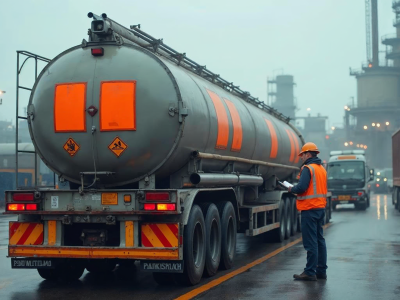



Fuel is one of the biggest expenses for any transport business.
However, fuel consumption can be reduced and optimized by using a fuel level sensor.
A truck fuel level sensor generates savings, so it becomes an investment that pays back more than its cost.
A truck fuel level sensor can measure the fuel in a vehicle’s tank whether the vehicle is stationary or moving.
Besides letting us know the actual fuel consumption of each vehicle, truck fuel level sensors detect refueling volumes and drains. This prevents large amounts of fuel from being siphoned off on every trip.
The truck fuel level sensor sends the data to another interface, which in most cases is a GPS unit.
To improve vehicle efficiency and prevent fuel theft from the tank, install a GPS-enabled fuel monitoring system.
Fuel monitoring solutions are widely used by logistics and transport companies around the world.
A fuel monitoring system will tell you how much fuel is left in the vehicle.
This truck fuel level sensor is designed to help you monitor and manage your vehicles’ fuel efficiency.
You will also receive detailed reports on every refueling, such as the time and place of refueling, how many liters were filled, how many liters were consumed, etc.
In addition, this truck fuel level sensor lets you determine the exact fuel volume and any change in volume, i.e., fuel being added to or drained from the tank.
Key benefits of using a truck fuel level sensor

Real-time fuel level tracking
A truck fuel level sensor provides a more accurate, reliable and stable fuel reading, even in extreme conditions. It can be used to measure, in real time, the fuel level in the vehicle’s tank and in storage tanks.
Cost-per-kilometer reports
A fuel monitoring system generates reports that calculate the kilometers driven by the fleet and the amount of fuel it consumed, which in turn enables the user to easily calculate the cost per km, track fleet mileage and assess performance levels.
Real-time alerts for refueling and drains
Today, drivers can easily manipulate fuel invoices. So if you want information such as the volume of fuel added and the time and station of refueling, installing a fuel level sensor will reduce waste and make fuel consumption more efficient.
With GPS monitoring systems and fuel level sensors, you can obtain the following information:
- SMS or e-mail alerts for refueling and drains;
- Refueling and drain locations shown on the map;
- Complete refueling and drain reports;
- Alerts can be set to warn you about high or low fuel levels.
Fuel consumption and kilometers-per-liter report
With the detailed reports and statistics of the GPS monitoring system, you can calculate the exact consumption of each vehicle.
As a fleet manager, you can analyze each vehicle’s weekly or monthly fuel consumption per kilometer and identify which vehicles are not fuel-efficient.
The CargoTrack fuel level sensor
The CargoTrack fuel level sensor connected to the GPS monitoring system is a solution that guarantees 99% accuracy in fuel monitoring. The digital sensors measure the fuel level across the entire height of the tank, eliminating blind spots. The CargoTrack solution helps you track changes in fuel level and is the perfect equipment for cutting fuel-related costs.
Benefits of the CargoTrack fuel monitoring solution
- Consumption calculation for given routes: find out exactly how much fuel is used on a given route.
- With the CargoTrack platform, you can see whether there are consumption differences on the same route driven by different drivers and calculate the long-term financial impact.
- Profitability assessment: The CargoTrack solution helps you determine your exact fuel costs when preparing transport quotes.
- Theft of fuel: installing fuel level sensors deters fuel theft, which means the investment in the device pays for itself in a very short time.
- The solution is also compatible with very large diesel, gasoline or gas tanks.
- Fuel drop notifications: you are notified by e-mail or SMS whenever the fuel level drops.
- Refueling notifications: you get an e-mail or SMS every time the vehicle is refueled.
Truck Fuel Level Sensors – Questions and Answers
1. What is a fuel level sensor and why should I care?
It is a device that tells you exactly how many liters are in the tank at any moment. On trucks it is extremely useful: you see actual consumption, catch any theft and keep much better control over diesel costs.
2. How exactly does a truck fuel level sensor work?
A truck fuel level sensor is mounted in the tank and measures the fuel level through a sensor. It sends the data to the truck’s GPS or telematics system, which calculates the exact consumption and keeps a record of every refueling or stop.
3. Is a truck fuel level sensor more accurate than the consumption shown by the on-board computer?
Definitely. The dashboard gauge gives you an approximation, whereas the sensor tells you literally how many liters are in there. The difference really shows when you want to save money or suspect diesel is disappearing with no explanation.
4. Can I catch fuel theft with a truck fuel level sensor?
That is exactly what it excels at. If someone siphons diesel, the sensor detects the sudden drop and sends an instant alert — either to the monitoring center or straight to the manager’s phone.
5. What do I gain by installing fuel level sensors across my whole fleet?
You gain control: you see exactly how much each truck consumes, identify drivers who are too heavy on the pedal, prevent theft, receive detailed reports and can plan your fuel budget much better.
6. Does it work on any truck, or do I need something special?
In principle, it works on any model. There are solutions adapted even for oddly shaped tanks or tanks with internal reinforcement bars — what matters is to work with an experienced company.
7. Is it complicated to install such a sensor?
It has to be done by someone who knows the job — it involves fitting it in the tank, precise calibration and connecting it to the telematics system. Installed properly, it measures perfectly; if not, you may run into problems.
8. Does it connect directly to the truck’s GPS?
Yes, and that is the whole point. Good systems send the sensor data through the existing GPS unit, so you see exact consumption, live, on every route — all on a single platform.
9. How often does it need to be checked or recalibrated?
Periodically, according to the manufacturer’s or the transport company’s instructions. Timely calibration maintains accuracy and spares you incorrect readings.
10. Will it really save me money, or is it just a gadget?
It depends on how much you are losing now. For a large fleet, the difference can be dramatic: you catch theft, optimize routes and correct driving style — all of which translate into substantial savings every month.