
Dangerous goods are divided into 9 ADR classes, and some of them have divisions: class 1 explosives (1.1–1.6), class 2 gases (2.1–2.3), class 3 flammable liquids, class 4 flammable solids (4.1–4.3), class 5 oxidizing substances and peroxides (5.1–5.2), class 6 toxic and infectious substances (6.1–6.2), class 7 radioactive material, class 8 corrosive substances and class 9 miscellaneous dangerous substances.
Classification isn’t an office formality: together with the packing group, it determines how the goods are packed, which labels the packages carry, which plates go on the vehicle and what equipment must be on board. The data below comes from the official material of the Romanian Road Authority (ARR) on the transport of dangerous goods.
The 9 ADR classes and their divisions
| Class | Name | Divisions |
| 1 | Explosive substances and articles | 1.1 – 1.6 |
| 2 | Gases | 2.1 flammable gases · 2.2 non-flammable, non-toxic gases · 2.3 toxic gases |
| 3 | Flammable liquids | — |
| 4 | Flammable solids and related substances | 4.1 flammable solids, self-reactive substances, polymerizing substances and solid desensitized explosives · 4.2 substances liable to spontaneous combustion · 4.3 substances which, in contact with water, emit flammable gases |
| 5 | Oxidizing substances and peroxides | 5.1 oxidizing substances · 5.2 organic peroxides |
| 6 | Toxic and infectious substances | 6.1 toxic substances · 6.2 infectious substances |
| 7 | Radioactive material | — |
| 8 | Corrosive substances | — |
| 9 | Miscellaneous dangerous substances | — |
The consignor — the person or company handing over the goods for transport — is responsible for classifying, packing and marking dangerous goods, as well as for drawing up the transport document. Not the carrier. However, this does not exempt the carrier from the checks it must carry out when taking over the goods.
Packing groups: the second criterion
In addition to the class, substances are assigned a packing group according to their degree of danger:
- Packing group I — high danger substances;
- Packing group II — medium danger substances;
- Packing group III — low danger substances.
Packing groups do not apply to substances in classes 1, 2, 5.2, 6.2 and 7, to self-reactive substances in class 4.1, or to articles. The specific assignment is shown in Table A of Chapter 3.2 of the ADR.
Marking and labeling packages
Consignors must mark and label packages in accordance with Chapters 5.1 and 5.2 of the ADR. The basic rules:
- The UN number of the goods, preceded by the letters “UN”, must be displayed clearly and durably on each package;
- The labels applied are those indicated in column (5) of Table A in Chapter 3.2, unless a special provision in column (6) states otherwise;
- Salvage packagings and salvage pressure receptacles additionally bear the mark “SALVAGE”;
- An overpack is marked with the word “OVERPACK” and with the UN number preceded by “UN,” is labeled like a package, and bears the “environmentally hazardous substance” mark for each item of goods it contains — unless marks representative of all the goods inside are visible.
The “OVERPACK” mark must be in the official language of the country of origin and, if that is not English, French or German, also in one of these three languages.
UN-approved packagings for liquids and solids are marked with the prefix “UN,” while those approved only for RID/ADR bear the mark “RID/ADR,” followed by the codes from Part 6 of the ADR.
Orange plates and vehicle placarding
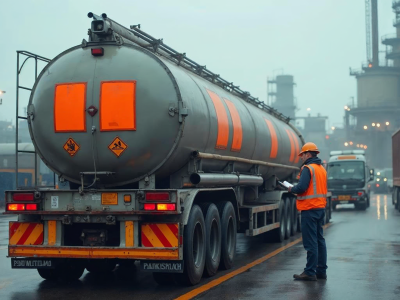
Transport units carrying dangerous goods must display two rectangular orange-colored plates, set in a vertical plane — one at the front and one at the rear, perpendicular to the longitudinal axis of the transport unit, in accordance with 5.3.2.2.1 of the ADR.
Placards corresponding to the labels prescribed in column (5) — and, where applicable, column (6) — of Table A are affixed to the sides of containers, MEGCs, MEMUs, tank-containers, portable tanks and vehicles. For packages, side placarding of vehicles applies only to classes 1 and 7.
A special case that’s easy to miss: transport units with a maximum mass over 12 tons carrying packages of dangerous goods in limited quantities must be marked in accordance with 3.4.15, at the front and rear — except when they also carry other dangerous goods for which orange plates are already required.
Fire extinguishers: sized according to vehicle weight
| Maximum permissible mass of the transport unit | Minimum total capacity | Extinguisher for the engine compartment / cab | Additional extinguisher |
| ≤ 3.5 tons | 4 kg | min. 2 kg | min. 2 kg |
| > 3.5 and ≤ 7.5 tons | 8 kg | min. 2 kg | min. 6 kg |
| > 7.5 tons | 12 kg | min. 2 kg | min. 6 kg |
Mandatory on-board equipment
Each transport unit carrying dangerous goods must be equipped in accordance with 8.1.5.2, and the equipment is chosen based on the danger label number of the goods loaded — a number identified in the transport document.
For each vehicle:
- A wheel chock of a size suited to the vehicle’s maximum mass and wheel diameter;
- Two self-standing warning signs;
- Eye rinsing liquid — not is required for danger labels 1, 1.4, 1.5, 1.6, 2.1, 2.2 and 2.3.
For each crew member: a high-visibility vest, a portable lighting apparatus complying with 8.3.4, a pair of protective gloves and eye protection.
Additional equipment, depending on labels:
- Emergency escape mask for each crew member — for loads with labels 2.3 or 6.1;
- A shovel, drain seal and collecting container — only for solids and liquids with labels 3, 4.1, 4.3, 8 and 9.
The transport document, LQ and EQ
Dangerous goods must be accompanied by a transport document that includes a description of the goods and certain characteristics, in accordance with Chapter 5.4 of the ADR. The exceptions are goods packed in limited quantities (LQ) OR excepted quantities (EQ).
- Limited quantities (LQ) — packages bear the mark from 3.4.7 or 3.4.8 of the ADR, as applicable;
- Excepted quantities (EQ) — packages bear the mark from 3.5.4.2, packagings must comply with Chapter 3.5, and the transport document includes the statement “Dangerous Goods in Excepted Quantities” and the number of these packages.
The description of the dangerous goods also appears on the consignment note: Article 6(1)(f) of the CMR Convention requires that, for dangerous goods, their generally recognized description be entered — see the guide on filling in the CMR box by box.
Which edition of the ADR applies
The ADR is revised every two years, and the applicable edition enters into force on January 1 of the corresponding odd-numbered year (2023, 2025, 2027), with a transition period for moving from the previous edition. The Romanian versions of Volumes I and II are published by the ARR, while the English, French and Russian editions are available on the UNECE website.
Always check the edition in force at the time before relying on a code, mark or special provision: chapter numbering remains stable, but the content of special provisions changes from one edition to the next.
Drivers carrying out such transport need an ADR certificate appropriate to the goods and the mode of transport — the requirements, cost and renewal are covered in the guide on the ADR certificate. For traceability of ADR trips — routes, stops, idle time, deviation alerts — see the solution for CargoTrack GPS monitoring OR talk directly with the team.
Frequently asked questions about ADR classes
How many ADR classes are there?
Nine classes: 1 explosive substances and articles, 2 gases, 3 flammable liquids, 4 flammable solids and related substances, 5 oxidizing substances and organic peroxides, 6 toxic and infectious substances, 7 radioactive material, 8 corrosive substances and 9 miscellaneous dangerous substances. Classes 1, 2, 4, 5 and 6 have divisions.
What do packing groups I, II and III mean?
Packing group I means high danger substances, packing group II medium danger substances and packing group III low danger substances. Packing groups do not apply to substances in classes 1, 2, 5.2, 6.2 and 7, to self-reactive substances in class 4.1, or to articles.
Who is responsible for classifying dangerous goods?
The consignor, meaning the person or company handing over the goods for transport. The consignor is responsible for classifying, packing and marking dangerous goods, as well as for drawing up the transport document.
How many fire extinguishers must an ADR vehicle have?
It depends on the maximum permissible mass of the transport unit: up to 3.5 tons, a minimum total capacity of 4 kg; between 3.5 and 7.5 tons, 8 kg; over 7.5 tons, 12 kg. In all cases, at least one extinguisher of minimum 2 kg is intended for a fire in the engine compartment or cab.
Where are the orange plates placed on the vehicle?
Two rectangular orange-colored plates, set in a vertical plane, one at the front and one at the rear of the transport unit, perpendicular to the longitudinal axis, in accordance with 5.3.2.2.1 of the ADR.
What do LQ and EQ mean in ADR transport?
LQ means limited quantities, governed by Chapter 3.4 of the ADR, and EQ means excepted quantities, governed by Chapter 3.5. In both cases, packages bear specific markings and the goods are exempt from the transport document in its usual form — for EQ, the document must still include the statement “Dangerous Goods in Excepted Quantities” and the number of packages.