

Since October 1, 2026, TollRo has been one of the most discussed topics among Romanian hauliers. In most European countries, road transport operators are already used to paying road tolls to travel on national networks. This need also led to the development of automatic payment systems – devices or digital solutions that let tolls be paid quickly and efficiently, without unnecessary stops.
Watch out for two different dates. The TollRo system must be implemented by August 31, 2026 (Law no. 170/2026, art. 12), but the rates actually apply from October 1, 2026, both for TollRo and for the rovinieta (Law no. 226/2023, art. 29). Interoperability with the systems of other EU countries, via SETRE (the European Electronic Toll Service), becomes operational on January 15, 2027.
In Romania, the TollRo changed, as of October 1, 2026, the way heavy freight vehicles are charged for using the road infrastructure. Instead of the traditional rovinieta (Romanian road vignette), the toll is calculated based on the distance driven and the vehicle’s characteristics, bringing Romania in line with modern European practice.
What is TollRo and when does it take effect?
TollRo is the new toll system for road use, applied in Romania starting October 1, 2026, to goods vehicles over 3.5 tons.
It replaces the rovinieta for trucks and introduces a pricing model based on kilometers driven, similar to those already in place in other European countries.
If you run international transport and already know the Hungarian system, the point-by-point comparison is in the article on the differences between TollRo and HU-GO.
You can estimate the cost for your fleet in a few seconds with the TollRo calculator, without doing the multiplication by hand.
The legal framework is set by Law no. 226 of July 17, 2023, which originally set the entry into force for January 1, 2026. After two successive postponements, Law no. 170/2026, promulgated and published in Official Gazette (Monitorul Oficial) no. 648 of August 5, 2026, set the infrastructure deadline at August 31, 2026, and TollRo applies starting October 1, 2026, at 00:00, a date confirmed by CNAIR (Romanian road infrastructure company) on September 25, 2026, for goods vehicles with a maximum authorized weight over 3.5 tons.
Update — the TollRo timeline, from postponement to an earlier start
On June 10, 2026, a vote postponed the TollRo deadline to October 1, 2026. Subsequently, through Law no. 170/2026, promulgated and published in Official Gazette no. 648 of August 5, 2026, the infrastructure implementation deadline was moved up to August 31, 2026, but the rates still apply from October 1, 2026, under Art. 29 of Law no. 226/2023.
It was also established that passenger transport vehicles, freight vehicles under 3.5 t and passenger cars can continue to use the rovinietas already purchased until they expire.
The difference between TollRo and the rovinieta for trucks
The major difference between the two systems lies in the calculation method of the toll.
- The rovinieta is purchased for a set period (e.g., 1 day, 10 days, 30 days, 60 days or 12 months), regardless of how many kilometers are driven.
- TollRo, on the other hand, takes into account the number of kilometers driven, the maximum authorized weight of the vehicle, its Euro emission class and the Road type.
This new charging model is more accurate and fairer, because it reflects each vehicle's real impact on infrastructure and the environment.
What is a per-kilometer tolling system?
A per-kilometer tolling system is a road-use payment model in which drivers pay in proportion to the distance actually driven, instead of traditional flat fees such as the vignette (the rovinieta in Romania), which is paid once for a set period no matter how much you drive.
This system is already used in other European countries such as Hungary, Bulgaria, Poland, Germany and Austria.
What changed on October 1, 2026
From October 1, 2026, at 00:00, TollRo is in effect. Besides the switch from the rovinieta to per-kilometer payment, a few new rules affect you directly:
- Accounts from the pilot period. If you had an account during the pilot period, register with the same email address: CNAIR (Romanian road infrastructure company) links the account to the profile, billing details, vehicles and trailers entered at that time. With a different email, you have to re-enter all company and vehicle data. Download the app only from Google Play, the App Store or the official etoll.ro portal.
- Closing the session after the trip. Close the charging session as soon as you finish the trip, not just when you turn off the engine. Outside an active session, the app does not collect location data: the real risk is a session left running, not an account that stays logged in.
- The toll for the Fetești – Cernavodă bridge. Fetești – Cernavodă bridge tolls bought in the old system and left unused expired on October 1, 2026; the remaining crossings are refunded upon request through the CNAIR refund app. If your vehicle has to pay the bridge toll in the new system, check etoll.ro, under the Peaj (Toll) section, before your trip.
- Rovinieta refunds have clear rules. The implementing rules published on September 30, 2026, set out how to file the claim, the calculation formula and the time frame for receiving the money. Details are in the next section.
- Fines apply. Fines apply from October 1, 2026. A bill that would suspend fines until March 31, 2027 was submitted to the Senate but has not been adopted. You are not penalized if you could not pay because of a TollRo platform malfunction (art. 9 para. (4) of the implementing rules), provided that before departure you tried to create an account, enroll the vehicle and pay: attempts are logged by the system (CNAIR press release of October 6, 2026).
What happens to the rovinieta you’ve already bought
It’s the question with the biggest financial impact of the entire transition, and it’s missing from most material about TollRo. The answer depends on the vehicle type.
| Vehicle | What happens to the rovinieta |
|---|---|
| Goods transport, over 3.5 t | It ceases to be valid on October 1, 2026, even if it still has months remaining |
| Goods transport, up to 3.5 t | Remains valid until it expires |
| Passenger transport, regardless of weight | Remains valid until it expires |
For vehicles moving to TollRo, the money for the remaining period can be recovered, but it is not refunded automatically. CNAIR refunds the value of the remaining days only at the haulier’s request, under Art. 24(4) of Law no. 226/2023 and Art. 39 of the Implementing Rules approved by MTI Order no. 922/2026, published in Official Gazette no. 832 of September 30, 2026. The rovinieta is not automatically converted into TollRo credit.
- Where to file the claim: with CNAIR, not with the distributor you bought the rovinieta from. According to CNAIR (press release of October 6, 2026), the application can be submitted exclusively through the refund app that CNAIR will make available by December 29, 2026; the launch date will be announced on the CNAIR website.
- How much you get: S = T × Zn / Zt, where T is the rate paid, including VAT, Zn is the number of days from October 1, 2026, to the rovinieta’s expiry, both inclusive, and Zt is the total number of days of validity. Transfer costs and the distributor’s or payment processor’s fee are deducted from the amount.
- When the money arrives: within 90 days of the application being registered in the app, by bank transfer, as a balance in the CNAIR mobile app or, where possible, back to the payment instrument used for the purchase.
- Paid but unused tolls are refunded under the same rule: the number of remaining crossings multiplied by the per-crossing rate, with the same deductions.
Across a fleet, the amount adds up. Example for category F, a 12-month rovinieta at 7,262.23 lei: if it is valid January 1 – December 31, 2026, 92 of 365 days remain, i.e., 7,262.23 × 92 / 365 = 1,830.48 lei per truck; if it is valid September 1, 2026 – August 31, 2027, 335 days remain, i.e., 6,665.33 lei.
How to submit the application, the required documents and the steps are explained in detail in the guide on what happens to an unused rovinieta when switching to TollRo.
Who does TollRo apply to?
Which vehicles pay TollRo?
The new system applies to goods vehicles with a maximum authorized weight over 3.5 tons.
While these vehicles previously used the rovinieta to travel legally on Romanian roads, since TollRo took effect on October 1, 2026, hauliers have been required to pay road tolls based on the distance driven, through the new platform.
Does TollRo also apply to passenger cars?
TollRo does not apply to cars.
For cars, minibuses, coaches and goods vehicles up to 3.5 tons, the rovinieta remains valid, which means this measure directly targets domestic and international commercial transport operators.
How is the TollRo toll calculated?
Until now, the rovinieta in Romania was paid for a set period, regardless of the distance driven on the country’s roads.
By contrast, under the TollRo system, payment is calculated based on distance driven, MTMA, Euro class and road type (highway/expressway or national road).
The TollRo toll is obtained by multiplying the unit rate by the distance driven. The calculation is simple, as the toll is made up of:
- The unit rate, which reflects road maintenance and environmental costs, set by the Ministry of Transport.
- The distance driven by the vehicle, in kilometers, on a given road.
The goal is to encourage hauliers to choose lower-emission vehicles, which is why the rate is lower for vehicles with a newer Euro class and lowest for electric trucks.
Per-kilometer rates by Euro class
This information on TollRo was published in Official Gazette no. 940 of October 10, 2025, supplemented by OMTI 959/2026 (in force since October 8, 2026), which adds separate rates for electric trucks.
| Unit rate category | Vehicle category | Road category | Unit rate/km (lei, VAT included) | |||
| Electric | EURO VI | EURO V-IV | EURO III-0 | |||
| S | Freight vehicle with an MTMA over 3.5 tons and up to and including 7.5 tons | Highways and expressways | 0,04 | 0,17 | 0,19 | 0,22 |
| National roads | 0,02 | 0,08 | 0,10 | 0,11 | ||
| II | Freight vehicle with an MTMA over 7.5 tons and under 12.0 tons | Highways and expressways | 0,07 | 0,29 | 0,33 | 0,37 |
| National roads | 0,03 | 0,14 | 0,16 | 0,19 | ||
| III | Freight vehicle with an MTMA of 12.0 tons or more | Highways and expressways | 0,12 | 0,48 | 0,55 | 0,62 |
| National roads | 0,06 | 0,24 | 0,28 | 0,31 | ||
How distance driven affects the cost
The longer the distance driven on the tolled roads, the higher the TollRo price.
How Do You Pay TollRo?
Since October 1, 2026, the new toll is paid through the TollRo app or on etoll.ro
Until January 15, 2027, you have two options, both within the CNAIR system:
- Route ticket: you declare the route, see the cost and pay before departure. You buy it from the TollRo app, on etoll.ro, at CNAIR points of sale and at border crossing points, not at gas stations. It is valid for a maximum of 72 hours from the declared start of the trip, for a single journey, strictly in the calculated direction.
- The charging session: the driver starts it in the TollRo app before departure and closes it at the end; the route is recorded per kilometer based on the phone’s GPS, and the toll is deducted from the e-wallet. It only works from the TollRo app, and the phone must stay with the driver, with signal, internet and location access turned on. If the phone stops transmitting its position for a longer period (signal, location, battery), the session stops automatically, and the toll remains due for the distance actually driven; continuing the trip without a ticket or an active session is at your own risk (etoll.ro Terms and Conditions). If the failure is on the platform’s side, you are not penalized (art. 9 para. (4) of the implementing rules).
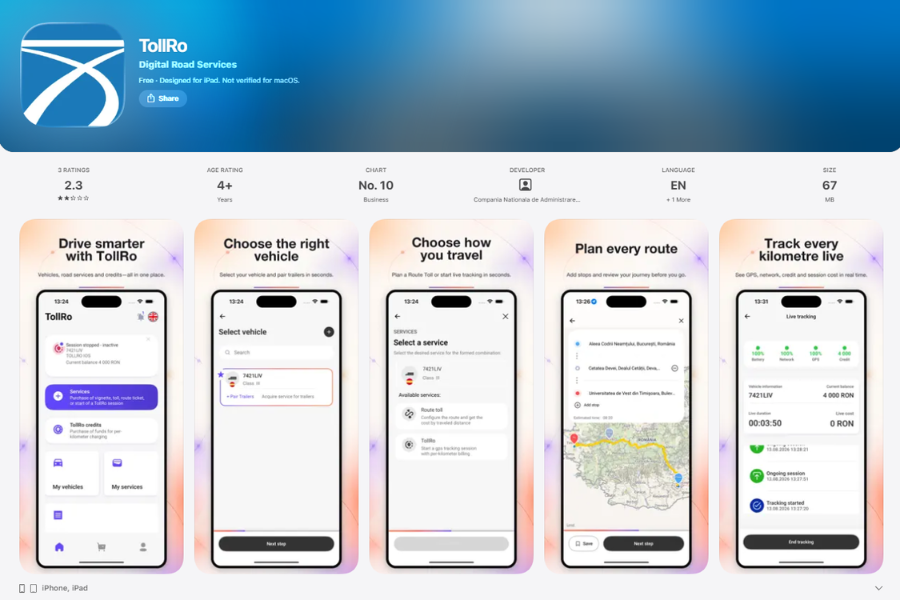
On etoll.ro you create an account, enroll your vehicles and fleet, top up your e-wallet and find your invoices. The steps are explained in detail in the guide on how to pay TollRo. The TollRo app is free and you can download it here:
Automatic Payment with a Toll Device
A contract with a service provider – ideal for hauliers who frequently run domestic trips and regularly use Romanian roads. Under this contract, an agreement is made with an authorized provider, which automatically handles road toll payments on the haulier’s behalf.
Note! TollRo can be paid via an on-board device only starting January 15, 2027, through CNAIR-authorized providers.
How it compares with Hungary’s HU-GO
The two systems work on the same principle. Heavy vehicles over 3.5 tons are charged per kilometer based on distance driven, vehicle category and emission class, paid electronically through an on-board device or an app.
In Romania, paying TollRo via on-board equipment will be possible from January 15, 2027. Until then, it is paid via a route ticket or a per-kilometer session in the TollRo app. A GPS fleet tracking device does not pay TollRo at this time.

Want to pay TollRo automatically?
Automatic payment with an on-board unit will be possible from January 15, 2027, through CNAIR-authorized providers. The CargoTrack solution is in the works and is not yet available. Join the waiting list and we’ll let you know when it launches.
What Happens If You Don't Pay the TollRo Toll?
The law distinguishes between the toll owed and the fine.
- If the distance driven without payment can be determined, you owe TollRo calculated for those kilometers.
- If the distance cannot be determined, for example when you drive without a route ticket and without an active session, the TollRo due is 2,000 lei, applied once per 12-hour period. This is the toll due, not the fine.
- If you pay the amount due on time, no penalties apply. The deadline is 72 hours from receipt of the notice letter (Law no. 226/2023, art. 19).
- If you don’t pay on time, the fine is 10 to 20 times the TollRo amount due, when the distance can be determined, or 5,000 lei, when it cannot.
The legal basis is art. 19 para. (4)-(17) of Law no. 226/2023. Fines apply from October 1, 2026. A bill that would suspend fines until March 31, 2027 was submitted to the Senate but has not been adopted. Exception: you are not penalized if you could not pay because of a platform malfunction and you tried before departure.

Implementing the TollRo system is an important step for Romania.
In most European countries, hauliers already pay road tolls to travel on national networks. Romania is thus aligning with a modern tolling model based on distance driven and impact on infrastructure.
Without a doubt, the transition is a difficult one for many operators in the industry, but adapting is necessary to keep operating legally and competitively.
For up-to-date transport news, follow us on social media or Contact us.
All TollRo guides, by topic
This guide sums up everything you need to know. For each topic, there is a detailed article:
- What is TollRo
- When TollRo takes effect and which dates matter
- Who TollRo applies to
- Which vehicles pay TollRo
- What MTMA Means for TollRo
- Which emission standards affect the TollRo toll
- How much TollRo costs per kilometer
- How the TollRo toll is calculated
- How to pay TollRo: route ticket and per-kilometer session
- Route ticket or on-board device: what to choose for your fleet
- Does TollRo apply on motorways
- The difference between TollRo and the rovinieta
- TollRo replaces the rovinieta for trucks
- Does TollRo apply to passenger cars
- A rovinieta bought for a truck: how to get your money back
- TollRo compared with Hungary’s HU-GO
- TollRo calculator: estimate the cost of a trip
Frequently asked questions
What is TollRo?
TollRo is Romania's per-kilometer road toll, which replaces the rovinieta for freight vehicles over 3.5 tons starting October 1, 2026.
When does TollRo take effect?
The TollRo toll applies from October 1, 2026, at 00:00.
Who does TollRo apply to?
TollRo applies to freight vehicles over 3.5 tons.
Which vehicles pay TollRo?
All freight vehicles over 3.5 tons must pay TollRo. Here are a few examples:
Freight vehicles, in three rate categories, based on maximum authorized weight (MTMA):
- Freight vehicles with an MTMA over 3.5 tons and up to and including 7.5 tons (category I)
- Freight vehicles with an MTMA over 7.5 tons and under 12 tons (category II)
- Freight vehicles with an MTMA of 12 tons or more, regardless of the number of axles (category III)
- Mixed-use vehicles (passengers and freight), treated as freight vehicles
- Tractor units with semi-trailers (tractor-trailers)
Passenger vehicles – minibuses, buses, and coaches – do not pay TollRo, regardless of weight: they remain on the rovinieta.
Does TollRo also apply to passenger cars?
No. Cars continue to pay the rovinieta, as do minibuses, coaches, and freight vehicles up to 3.5 tons.
How is the TollRo toll calculated?
The distance driven on the tolled network, in whole kilometers, is multiplied by the vehicle’s per-kilometer rate. The rate depends on the maximum authorized weight, Euro class and road type.
How much does TollRo cost per kilometer?
The TollRo toll is calculated per kilometer traveled, based on the vehicle's weight (MTMA), Euro emission class, and road type.
For combustion-engine vehicles, the rate ranges from 0.08 to 0.62 lei/km (VAT included), depending on weight category, Euro class and road type. Since October 8, 2026 (OMTI 959/2026), electric trucks have separate rates of 0.02–0.12 lei/km. For combustion-engine vehicles of 3.5–7.5 tons, the rate is 0.08–0.11 lei/km on national roads and 0.17–0.22 lei/km on highways and expressways.
For those of 7.5–12 tons, the rate is 0.14–0.19 lei/km on national roads and 0.29–0.37 lei/km on highways. Vehicles over 12 tons pay 0.24–0.31 lei/km on national roads and 0.48–0.62 lei/km on highways. Electric trucks pay the least, followed by Euro VI; Euro III–0 pay the most.
What is the difference between TollRo and the rovinieta?
- The rovinieta is purchased for a set period (e.g., 1 day, 10 days, 30 days, 60 days, or 12 months), regardless of how many kilometers are traveled, and remains in place for cars, minibuses, coaches, and freight vehicles up to 3.5 tons.
- TollRo, by contrast, takes into account the number of kilometers driven, the maximum authorized weight, the Euro class and the road type, and applies to goods vehicles over 3.5 tons.
How Do You Pay TollRo?
- Route ticket – you declare the route and pay before departure. You buy it from the TollRo app, on etoll.ro, at CNAIR points of sale or at border crossing points.
- TollRo per-kilometer session – only from CNAIR’s TollRo app. You top up the e-wallet in advance, start the charging session before departure, the app records the route based on the phone’s GPS, and the toll is deducted from the e-wallet.
*Important: make sure the app has permission to access the phone’s location. Without it, the route is not recorded. After the trip, close the session. - A contract with a service provider – possible only from January 15, 2027, via on-board equipment, with CNAIR-authorized providers; ideal for hauliers who frequently run domestic trips and regularly use Romanian roads. Under this contract, an agreement is made with an authorized provider, which automatically handles road toll payments on the haulier’s behalf.
Can I pay TollRo with a ticket?
Yes, you can pay TollRo with a route ticket, bought before entering tolled roads from the TollRo app, on etoll.ro, at CNAIR points of sale or at border crossing points. The ticket is not sold at gas stations. If you make frequent trips on Romanian roads, you can use the per-kilometer session in the app or, starting January 15, 2027, an on-board unit to make your work easier.
Can I pay TollRo automatically with a toll device?
Not yet. TollRo will be payable with a vehicle-mounted device starting January 15, 2027, through CNAIR-authorized providers. Until then, you pay via a route ticket or a per-kilometer session in the TollRo app.
What happens if I don't pay TollRo?
You owe the toll for the kilometers driven or, if the distance cannot be determined, 2,000 lei, once within a 12-hour period. If you pay it on time (72 hours from the notice letter), no penalties apply. Otherwise, the fine is 10-20 times the toll due or 5,000 lei (art. 19 of Law no. 226/2023). Fines apply from October 1, 2026. A bill that would suspend fines until March 31, 2027 was submitted to the Senate but has not been adopted. Exception: you are not penalized if you could not pay because of a platform malfunction and you tried before departure.
Does TollRo also apply on national roads?
Yes, TollRo applies on national roads, expressways and motorways managed by CNAIR. National road sections within city limits are exempt. It does not apply on county and local roads.
Does TollRo also apply on highways?
Yes, TollRo applies on highways, expressways, and national roads.
What does MTMA mean for TollRo?
MTMA is short for Masă Totală Maximă Autorizată (maximum authorized weight). MTMA for TollRo refers to the maximum weight a vehicle can legally have when fully loaded – that is, the weight of the empty vehicle plus the maximum permitted load (cargo, fuel, passengers, etc.). This value is listed in the vehicle's registration certificate and is set by the manufacturer.
Which emission classes affect the TollRo toll?
The rate has four emission tiers: electric vehicles (lowest), Euro VI, Euro V–IV and Euro III–0 (highest). For example, for category III on highways: 0.12 / 0.48 / 0.55 / 0.62 lei/km.
Does TollRo replace the rovinieta for trucks?
Yes. From October 1, 2026, at 00:00, trucks pay TollRo instead of the rovinieta, and rovinietas already purchased for them are no longer valid.
How does TollRo compare to HU-GO?
TollRo and HU-GO work on the same principle, i.e., charging based on distance driven, vehicle category and Euro emission class, the main difference being that HU-GO has been operating in Hungary for years, while TollRo applies in Romania starting October 1, 2026, for now via a route ticket or a per-kilometer session in the app; payment via an on-board unit (OBU) will be possible from January 15, 2027.
Who issues and collects TollRo?
TollRo is issued and collected by CNAIR (Compania Națională de Administrare a Infrastructurii Rutiere, the Romanian road infrastructure company). Under Law no. 226/2023, CNAIR is designated as the entity that levies and collects TollRo.
What do I do with a rovinieta I’ve bought if the vehicle moves to TollRo?
For freight vehicles over 3.5 tons, the rovinieta ceases to be valid on October 1, 2026. The value of the remaining days is refunded by CNAIR only on request, exclusively through the refund app that CNAIR will make available by December 29, 2026 (CNAIR press release of October 6, 2026). The amount is calculated with the formula S = T × Zn / Zt (rate paid × remaining days / total days of validity), minus transfer costs and fees, and is paid within 90 days of the application being registered in the app. Details in the guide on getting a refund for a rovinieta bought for a truck.