
Everyone is talking about the TollRo toll right now. After so many years in which Romanian hauliers paid the rovinieta (Romanian road vignette) only for domestic trips, they now have to adapt to a new toll system.
For the full picture – who pays, rates, payment methods, and what happens to the rovinieta – see the complete TollRo 2026 guide.
Watch out for two different dates. The TollRo system must be implemented by August 31, 2026 (Law no. 170/2026, art. 12), but the rates actually apply from October 1, 2026, both for TollRo and for the rovinieta (Law no. 226/2023, art. 29). Interoperability with the systems of other EU countries, via SETRE (the European Electronic Toll Service), becomes operational on January 15, 2027.
Still, this system is nothing unheard of. Road tolls are already paid in a similar way in Hungary (HU-GO) and Bulgaria (BGTOLL), where hauliers can pay road tolls automatically using toll devices.
What is TollRo?
TollRo is Romania's new per-kilometer road toll, in effect since October 1, 2026. Until then, all vehicle types paid the rovinieta (Romanian road vignette), priced by vehicle category (based on type, weight and number of seats) and by the chosen validity period, from one day to one year; on October 1, 2026, at 00:00, things changed.
For hauliers used to the system in Hungary, we have detailed the similarities and differences in our article on TollRo compared with HU-GO.
The rovinieta remains in place for cars, minibuses and coaches (regardless of weight), as well as for goods vehicles up to 3.5 tons. Trucks and other goods vehicles over 3.5 tons are charged per kilometer starting October 1, 2026.
The new road toll calculates charges differently, but similarly to neighboring countries (Hungary and Bulgaria). The toll is paid based on distance traveled, MTMA, Euro emission class and road type (highway/expressway or national road).
Now that you know what TollRo is and what role it plays in Romania’s road tolling system, it is much easier to understand how it affects hauliers, costs and the way national roads are used.
When Does the TollRo Toll Take Effect?
TollRo took effect on October 1, 2026.
The original deadline was January 1, 2026, but the project went into public consultation, and in August 2025 a postponement was obtained. The system has been running since October 1, 2026, at 00:00.
Officially, the postponement was approved because of delays in awarding the contract for developing and operating the IT system, as well as the need to ensure safe implementation.
Who Is Affected by TollRo?
Until recently, all vehicle types in Romania paid the rovinieta for road tolls. Now, however, since October 1, 2026, all freight vehicles over 3.5 tons must pay the new road toll, calculated based on distance traveled, MTMA, Euro emission class and road type.
Cars, minibuses, coaches and goods vehicles up to 3.5 tons continue to pay a time-based fee, the rovinieta.
Until January 15, 2027, TollRo can be paid in two ways: with a route ticket, bought before the trip in the TollRo app, on etoll.ro, at points of sale of CNAIR (Romanian road infrastructure company) or at border crossings, or with a charging session in the TollRo app, which the driver starts before departure and closes at the end; the route is recorded using the phone's GPS, and the toll is deducted from the e-wallet. From January 15, 2027, payment via on-board unit is added, through CNAIR-authorized providers. In countries with similar tolling systems, such as Hungary and Bulgaria, tolls are already paid with devices OBU, installed in the cab. A GPS fleet tracking device does not pay TollRo.
Want to pay TollRo automatically?
Automatic payment with an on-board unit will be possible from January 15, 2027, through CNAIR-authorized providers. The CargoTrack solution is in the works and is not yet available. Join the waiting list and we’ll let you know when it launches.
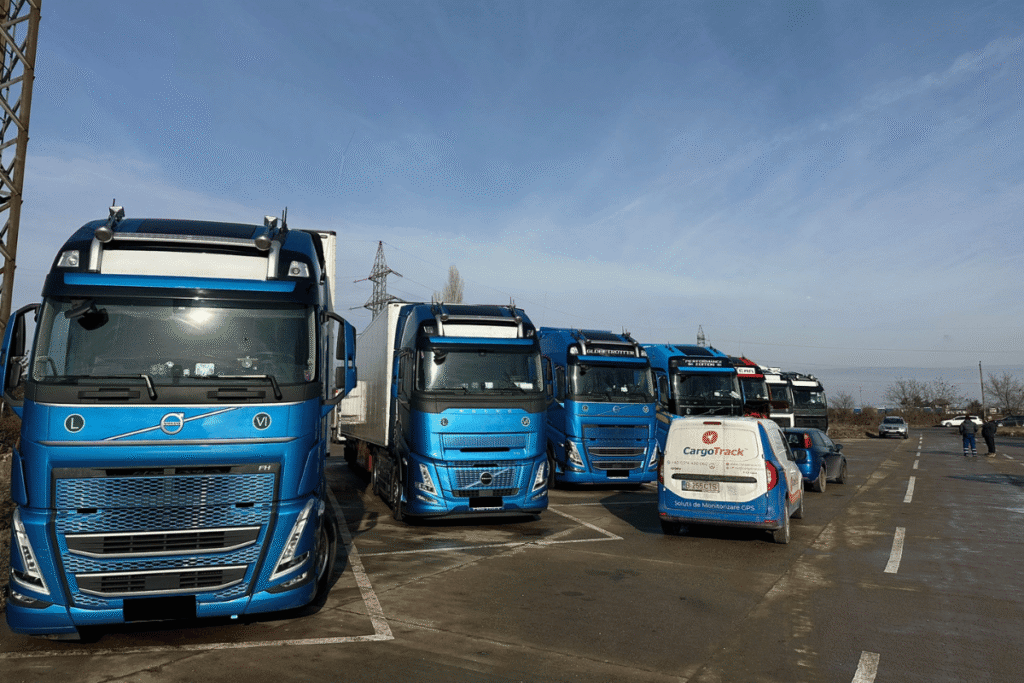
Since October 1, 2026, TollRo has brought a major change to many hauliers' routines. Even if the transition is difficult, hauliers must comply to avoid unwanted fines.
Want to be notified when TollRo can be paid automatically via an on-board unit (from January 15, 2027)? Join the waiting list above or Contact us.
Frequently Asked Questions – What Is TollRo
What is TollRo?
TollRo is Romania’s new road toll for goods vehicles over 3.5 tons, replacing the rovinieta system for this vehicle category.
When does the TollRo toll become mandatory?
TollRo payment is mandatory since October 1, 2026, at 00:00.
Which vehicles must pay the TollRo toll?
The toll applies to vehicles designed for freight transport with a maximum authorized weight (MTMA) above 3.5 tons and to mixed-use vehicles treated as such. Minibuses, buses and coaches do not pay TollRo, regardless of weight: they pay the rovinieta.
Which vehicle categories are covered by TollRo?
It covers goods vehicles over 3.5 tons, in three rate categories:
- Freight vehicles with an MTMA over 3.5 tons and up to and including 7.5 tons (category I)
- Freight vehicles with an MTMA over 7.5 tons and under 12 tons (category II)
- Freight vehicles with an MTMA of 12 tons or more, regardless of the number of axles (category III)
- Tractor units with semi-trailers (tractor-trailers)
- Mixed-use vehicles (passengers and freight), treated as freight vehicles
Passenger vehicles – minibuses, buses, and coaches – do not pay TollRo, regardless of weight: they remain on the rovinieta.
Are cars subject to TollRo?
No. Cars remain under the rovinieta system and continue to pay the rovinieta.
How is the TollRo amount determined?
The toll amount is determined by distance traveled, MTMA, Euro emission class and road type (highway/expressway or national road).
What are the TollRo rates per kilometer?
For combustion-engine vehicles, the rate ranges from 0.08 to 0.62 lei/km (VAT included), depending on weight category, Euro emission class and road type. Since October 8, 2026 (OMTI 959/2026), electric trucks have separate rates of 0.02–0.12 lei/km. Rates for combustion-engine vehicles:
- 3.5–7.5 tons: 0.08–0.11 lei/km (national roads) / 0.17–0.22 lei/km (motorways and expressways)
- 7.5–12 tons: 0.14–0.19 lei/km (national roads) / 0.29–0.37 lei/km (motorways)
- Over 12 tons: 0.24–0.31 lei/km (national roads) / 0.48–0.62 lei/km (motorways)
Electric trucks pay the least, followed by Euro VI; Euro III–0 pay the most.
How does TollRo differ from the rovinieta?
The rovinieta is bought for a fixed period (1 day, 10 days, 30 days, 60 days or 12 months) regardless of distance traveled and applies to cars, minibuses, coaches and freight vehicles up to 3.5 tons. TollRo, by contrast, charges strictly for distance traveled, taking into account MTMA, Euro emission class and road type, and applies to freight vehicles over 3.5 tons.
What payment methods are available for TollRo?
Until January 15, 2027, there are two payment methods; from January 15, 2027, payment via on-board unit is added:
- Route ticket — bought before the trip in the TollRo app, on etoll.ro, at CNAIR points of sale or at border crossings
- Charging session in the TollRo app — per kilometer, using the phone's GPS; the driver starts it before departure and closes it at the end, and the toll is deducted from the e-wallet
- From January 15, 2027: a contract with a CNAIR-authorized provider — automatic payment via on-board unit, recommended for hauliers with frequent trips
Can TollRo be paid with a route ticket?
Yes, route ticket payment is available and is the ideal solution for hauliers with one-off or occasional trips. The ticket is bought in the TollRo app, on etoll.ro, at CNAIR points of sale or at border crossings and is valid for 72 hours from the declared start time, for a single trip on the chosen route.
Can TollRo be paid automatically?
Not yet. Until January 15, 2027, the driver buys a route ticket or starts and closes the charging session in the TollRo app. From January 15, 2027, the toll can be recorded and paid automatically through an on-board unit from a CNAIR-authorized provider, recommended especially for hauliers that operate frequently on Romanian roads.
What are the risks of not paying TollRo?
Anyone driving without paying owes the toll: TollRo for the kilometers traveled, if the distance can be determined, or 2,000 lei, once per 12-hour period, if it cannot. If the amount owed is paid on time, no penalties apply; the deadline is 72 hours from receipt of the notification letter. Otherwise, the fine is 10 to 20 times the TollRo owed or, if the distance cannot be determined, 5,000 lei (Law no. 226/2023, Art. 19). Fines have applied since October 1, 2026. A bill that would suspend fines until March 31, 2027 was submitted to the Senate but was not adopted. Exception: you are not penalized if you could not pay because of a platform failure and you tried before departure.
Does TollRo also apply on national roads, not just motorways?
Yes, the TollRo toll applies on all three road types: national roads, expressways and highways, except for national road sections within city limits.
Are motorways also part of the TollRo toll network?
Yes, motorways are part of the road network covered by TollRo, along with expressways and national roads.
What does MTMA mean in the context of TollRo?
MTMA stands for maximum authorized weight and is the maximum legal weight of a fully loaded vehicle (empty vehicle + cargo + fuel + passengers). This value is listed on the registration certificate and set by the vehicle manufacturer.
How does the emission class affect the TollRo amount?
The rate has four emission tiers: electric vehicles (lowest), Euro VI, Euro V–IV and Euro III–0 (highest). For example, for category III on highways: 0.12 / 0.48 / 0.55 / 0.62 lei/km.
Will trucks still pay the rovinieta after TollRo is introduced?
No. Starting October 1, 2026, trucks switch entirely to the TollRo system and no longer pay the rovinieta.
How is TollRo similar to Hungary’s HU-GO system?
Both systems work on the same principle: tolls based on distance driven, vehicle category and Euro emission class, with payment by route ticket or on-board unit (OBU). The key difference is that HU-GO has been operational in Hungary for years, while TollRo has applied in Romania since October 1, 2026, for now via route ticket or charging session in the app; payment via on-board unit (OBU) will be possible from January 15, 2027.
Who is responsible for administering and collecting TollRo?
TollRo is administered and collected by CNAIR (Compania Națională de Administrare a Infrastructurii Rutiere – the Romanian road infrastructure company), in accordance with Law no. 226/2023.