



In short: In Italy, highways are paid at toll barriers, based on the kilometers traveled and the vehicle class, not with a vignette as in Romania. In 2026, after the 1.5% increase applied from January 1 on most highways, the indicative rate starts at around 7 euro cents/km for cars and goes up to around 21 euro cents/km for trucks on mountain sections — for example, Verona–Rome costs approximately 44 EUR for a car. Payment is made in euros, at toll stations (cash, card) or by electronic toll collection (Telepass, UnipolMove, MooneyGo), and failure to pay within 15 days leads to fines of roughly 87 to 345 EUR, plus the toll owed.
Planning a vacation in Italy and want to enjoy the experience in your own car? Are you transiting Italy or carrying out a transport job without knowing about Italy's road tolls? In this article we give you everything you need to know about Italy highway tolls in 2026.
Italy highway tolls in 2026: what has changed
Since January 1, 2026, tolls on most Italian highways — including the Autostrade per l’Italia network (about 3,000 km, among them the A1, A4 and A14) — have increased by 1,5%, in line with the inflation projected for 2026. There are exceptions: on the Brenner A22 the increase was 1.46%, on the A3 Naples-Salerno 1.925%, while on the A24/A25 (Strada dei Parchi) and on the Autostrade Alto Adriatico sections tolls remained unchanged, and on some stretches in Liguria they were even reduced.
As a guide, in 2026 the unit rate in lowland areas starts at about 7 euro cents/km for class A (cars) and goes up to about 18 euro cents/km for class 5 (trucks with 5 or more axles), while on mountain sections it ranges from about 8 to 21 euro cents/km. A few examples of routes relevant to Romanian drivers (class A car, one way, approximate values checked in July 2026):
- Tarvisio – Milan (A23 + A4): approximately 41 EUR;
- Bolzano – Verona (A22): approximately 13 EUR;
- Verona – Rome (A22 + A1): approximately 44 EUR;
- Genoa – Ventimiglia (A10): approximately 15 EUR.
The Mont Blanc and Fréjus Alpine tunnels also applied a 1.19% increase from January 1, 2026 (a one-way trip for a car now costs 56.40 EUR). On the electronic toll side, cheaper alternatives to Telepass have appeared — UnipolMove and MooneyGo, with subscriptions from about 2.50 EUR/month — which are especially useful if you drive in Italy often. For the exact toll on your route, use the official calculator on autostrade.it.
Italy has a relatively simple payment system and offers several payment methods for road tolls.
Keep in mind that Italy has a great many toll roads in addition to highways. For this reason, you should pay close attention to the route you choose and the tolled sections of road.
Whether you are a tourist in Italy or a haulier, here you'll find all the information you need to make sure you pay all Italy road tolls.
Types of Italy highway tolls
Italian highways have two types of tolls, depending on the highway traveled: variable tolls and fixed tolls.
All these tolls also take into account the vehicle type and its classification in the Italian class system, which we cover in section 2.
Attention! All Italy road tolls are paid in EUROS!
Indicative highway toll prices are:

Variable Italy highway toll
The variable toll applies on most highways in Italy and charges drivers based on the kilometers traveled. When entering the highway, the driver takes a ticket, and at the exit pays the Italy highway toll based on:
- The number of kilometers traveled;
- The vehicle class;
- The coefficient of each highway.
For how vehicles are classified, see section 2.
Fixed Italy highway toll
The fixed toll applied on certain highways refers to a fixed price set for traveling the highway, regardless of the number of kilometers traveled.
These sections are:
- Autostrada dei Laghi, on the bypasses around Milan;
- on the North and South ring roads of Milan;
- Section A3 of the Naples-Pompeii-Salerno highway;
- A12 Rome-Civitavecchia;
- A32;
- A33, Asti-Alba section;
- A24, Settecamini-Lunghezza section.
Vehicle categories for Italy highway tolls
The Italian system charges for driving on roads and highways based on the vehicle class.
A vehicle is assigned to a class based on its height at the first axle and the number of axles. Vehicles are thus divided into 5 classes:
- Class A 2: motorcycles and vehicles with a front axle height under 1.3 m, scooters with an engine displacement over 150 cc;
- Class B 2: Vehicles with 2 axles and a height over 1.3 m at the front axle;
- Class III: Vehicles with 3 axles;
- Class IV: Vehicles with 4 axles;
- Class V: Vehicles with 5 or more axles.
So whether you drive on a road section with variable or fixed tolls, they will also factor in your vehicle's class.
What's more, the road toll amount will also vary depending on the terrain, calculated per kilometer.
Payment methods for Italy highway tolls
Physical toll stations for Italy highways
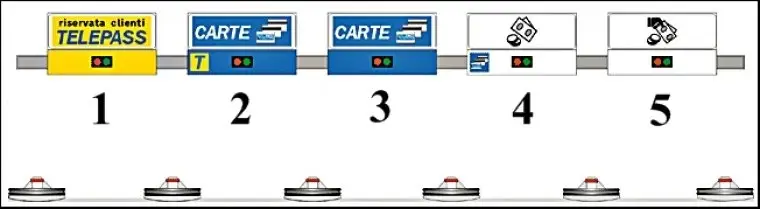
Driving on Italy's highways, at each payment point you will find 5 toll stations. Each of them accepts certain payment methods, and you can choose your preferred one.
- Toll station 1: vehicles fitted with the TELEPASS system;
- Toll station 2: Viacard, credit card, cash card and TELEPASS;
- Toll station 3: Viacard, credit card and cash card;
- Toll station 4: Cash, Viacard, credit card and cash card.
- Toll station 5: Cash, with a staff operator.
Paying Italy highway tolls online
Italy does not have an electronic vignette like Romania or Hungary — payment is made at the toll barrier or with electronic toll devices (Telepass, UnipolMove, MooneyGo). However, if you passed a barrier without paying, you can pay later online, within 15 days, through the highway operator's payment service (for example, on autostrade.it).
The classic option used to be the prepaid VIACARD. Note, however: Viacard cards have not been sold since October 2024. If you still have a Viacard purchased earlier, you can keep using it until December 31, 2029, and any remaining credit can be refunded afterward.
With this card, you pay at one of the toll stations that accept VIACARD and use the amount previously loaded onto the card.
However, the simplest and fastest payment option is the booth marked CARTE.
If the toll machines are not working properly due to faults or other objective reasons, the driver will be issued an invoice that must be paid within 15 days at most.
For any other information, feel free to visit autostrade.it.
Italy highway tolls for trucks
If you drive a large vehicle, keep in mind that the Italy highway toll for trucks increases with the vehicle's class, which in your case will be class 4 or class 5.
For trucks, indicative rates range from approximately 0.14 EUR to 0.21 EUR per kilometer, depending on the vehicle class (3, 4 or 5 axles) and the terrain — mountain sections are more expensive than lowland ones (indicative rates, checked in July 2026). You can pay by card, in cash or with electronic toll devices (Telepass, UnipolMove, MooneyGo) at the highway toll stations.
The prepaid VIACARD has not been sold since October 2024, but cards already purchased remain valid until December 31, 2029. For fleets, the modern alternative is an interoperable electronic toll device that automatically records and invoices passages. (see section 3)
One of the fastest and most efficient options for a haulier is the TELEPASS system installed in the vehicle. With it, you pass through toll stations 1 or 2 at a maximum of 30 km/h, and payment is processed automatically. Besides Telepass, alternative electronic toll operators also operate in Italy, such as UnipolMove and MooneyGo, with cheaper basic subscriptions (approximately 2.50 EUR/month, compared with 3.90 EUR/month for Telepass Base — rates checked in July 2026); international coverage, however, varies from one operator to another.
Find out everything else you need to know on autostrade.it.
Tunnel tolls in Italy
In addition to the Italy highway toll, Italy also charges tolls for the country's tunnels. These Italy tunnel tolls depend on the vehicle category (motorcycles / vehicles up to 3.5 tons and up to 2 m high / vehicles up to 3.5 tons and between 2-3 m high)
Since January 1, 2026, Mont Blanc and Fréjus tunnel tolls have increased by 1.19%, according to the decision of the Italian-French intergovernmental commission. The rates below are those valid in 2026 on the Italian side (22% VAT included), checked in July 2026. For more information on any of the tunnels, visit their official website.
| Tunnel | Motorcycles | Vehicles up to 3.5 tons, up to 2 m high | Vehicles up to 3.5 tons, 2-3 m high |
| Mont Blanc Tunnel — one way only | 37,30 € | 56,40 € | 74,70 € |
| Mont Blanc Tunnel — round trip (valid 7 days) | 46,90 € | 70,40 € | 93,80 € |
| Fréjus Tunnel — one way only | 37,30 € | 56,40 € | 74,70 € |
| Fréjus Tunnel — round trip (valid 7 days) | 46,90 € | 70,40 € | 93,80 € |
| Great St Bernard Tunnel — one way only | 20,00 € | 33,50 € | 52,50 € |
| Great St Bernard Tunnel — round trip (valid 30 days) | 28,00 € | 53,50 € | 84,00 € |
Penalties for not paying road tolls in Italy
If you do not pay the road toll within 15 days, you risk a fine of approximately 87 EUR to 345 EUR, plus the toll owed.
What's more, Italy is strict about speeding, and the speed limits are:
- In town: 50 km/h;
- Outside town: 90 km/h;
- On expressways: 110 km/h (90 km/h for drivers with less than 3 years of experience);
- On highways: 130 km/h (110 km/h in wet weather and for drivers with less than 3 years of experience).
Speeding fines are:
- up to 10 km/h: from 42 EUR;
- 11-40 km/h: from 173 EUR and 3 penalty points;
- 40-60 km/h: from 543 EUR, 6 penalty points and license suspension for 1-3 months;
- over 60 km/h: from 845 EUR, 10 penalty points and license suspension for 6-12 months.
Italy highway toll calculator 2026
Now that you have all the information you need to hit the road, you can calculate your Italy highway toll by visiting autostrade.it.
Remember that all payments in Italy are made in EUROS, and most roads are tolled.
Our road toll payment solutions
For transiting other countries, CargoTrack offers you the HU-GO system for Hungary, eTOLL for Poland and BGTOLL for Bulgaria.
Need a toll device for Italy? We can help!
Contact a CargoTrack consultant and get your Italy toll device!
At the same time, for high-performance management of your transport company, CargoTrack offers consultancy and provides the eTMS system, so you can control every variable of your business to the highest standards.
Frequently asked questions
How much is the highway toll in Italy in 2026?
In 2026, the unit rate in lowland areas starts at about 7 euro cents/km for cars (class A) and goes up to about 18 euro cents/km for trucks with 5 or more axles, while on mountain sections it ranges from about 8 to 21 euro cents/km. As a guide, a car pays approximately 41 EUR on the Tarvisio–Milan route, 44 EUR on Verona–Rome and 13 EUR on Bolzano–Verona, one way.
How do you pay the highway toll in Italy?
Italy does not have an electronic vignette like Romania or Hungary: when entering the highway you take a ticket, and at the exit you pay at the toll stations in cash, by card or with electronic toll devices such as Telepass, UnipolMove or MooneyGo. If you passed the barrier without paying, you can pay online later, within 15 days, through the highway operator's payment service.
How much does the Mont Blanc tunnel cost in 2026?
In 2026, after the 1.19% increase applied from January 1, a one-way trip through the Mont Blanc tunnel costs 56.40 EUR for a vehicle up to 3.5 tons and up to 2 m high, and a round-trip ticket (valid 7 days) costs 70.40 EUR. For motorcycles, one way costs 37.30 EUR, and the same rates apply to the Fréjus tunnel.
What fine do I risk if I don't pay the road toll in Italy?
If you do not pay the road toll within 15 days, you risk a fine of approximately 87 EUR to 345 EUR, plus the toll owed.
How much does a truck pay on Italian highways?
For trucks, indicative rates in 2026 range from approximately 0.14 EUR to 0.21 EUR per kilometer, depending on the vehicle class (3, 4 or 5 axles) and the terrain, with mountain sections more expensive than lowland ones. Payment can be made by card, in cash or with electronic toll devices such as Telepass, UnipolMove or MooneyGo.
Can the Viacard still be used in Italy?
Since October 2024, Viacard cards are no longer sold, but if you already have one purchased earlier you can keep using it until December 31, 2029, and any remaining credit can be refunded afterward.





